How to Design a Liquid Cooling Plate with Stainless Steel tube.
In the practical application of liquid cooling heat dissipation products, we have long addressed the on-site working condition pain points of front-line customers: most end customers cannot use pure water as coolant throughout the process, and tap water or weakly corrosive coolant containing impurities becomes the conventional choice. However, traditional liquid cooling plates with aluminum or copper flow channels in the industry will inevitably suffer from flow channel oxidation, corrosion, perforation and leakage after long-term operation under such working conditions. In mild cases, the heat dissipation efficiency drops sharply, and in severe cases, equipment failure and liquid circuit damage occur.
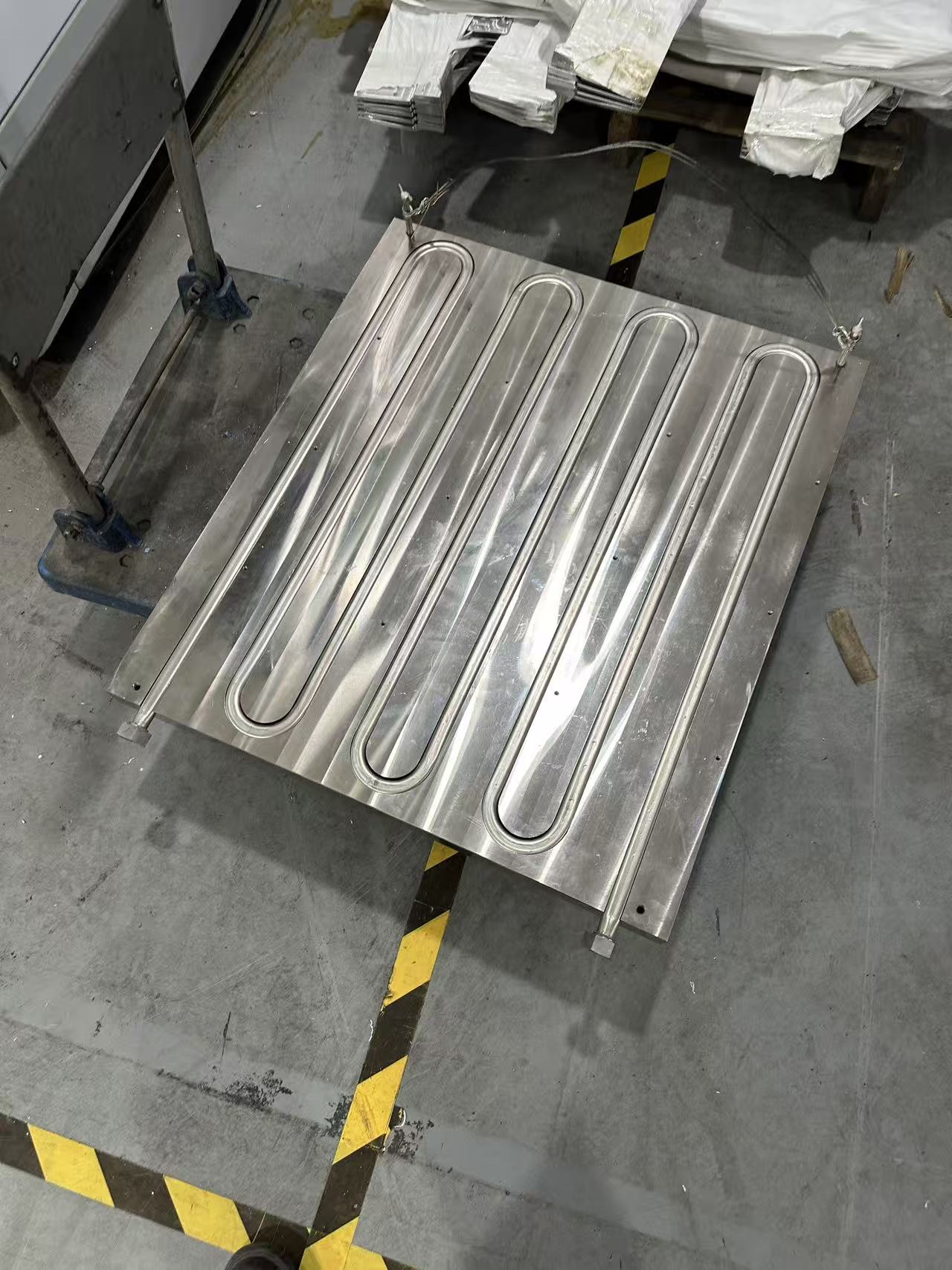
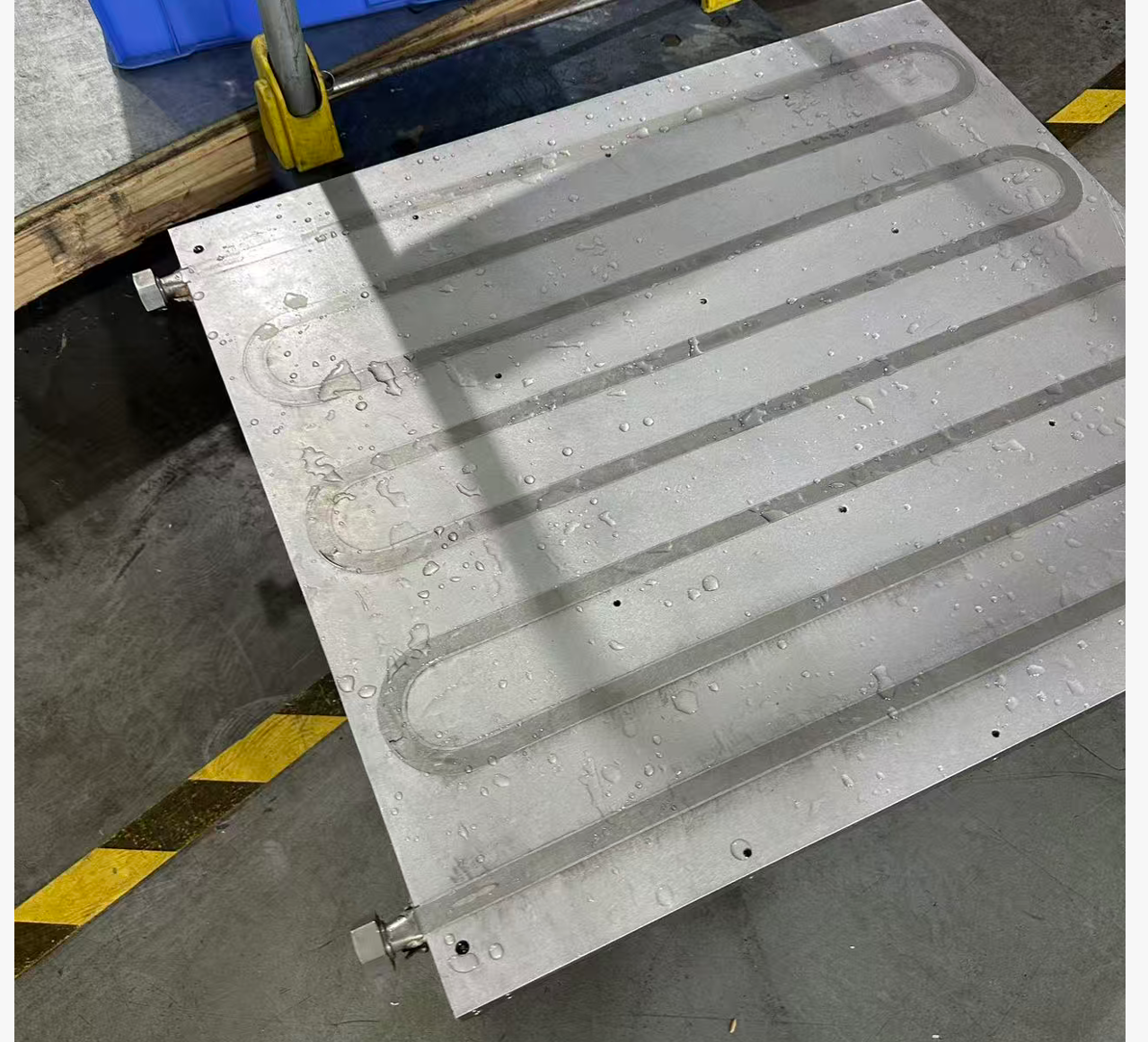
Based on years of practical experience in R&D and production of thermal management products, we have abandoned the commonly used integrated aluminum and copper flow channel designs in the industry, and independently developed an aluminum-based embedded stainless steel tube liquid cooling plate. For the standardized product with specifications of 600mm×600mm×30mm, we have formed a unique production process plan covering the whole process of material selection, structural design, stress deformation control, dissimilar metal thermal conductive welding and finishing adaptation. This plan completely solves the problem of flow channel corrosion under corrosive working conditions, and overcomes the three core technical barriers of stress deformation, insufficient thermal conductivity and work hardening in the combination of stainless steel and aluminum, creating an exclusive liquid cooling plate that is truly suitable for actual working conditions.
1 Core Design Original Intention of Self-Developed Stainless Steel Flow Channel Liquid Cooling Plate
The selection of flow channel material for liquid cooling plate is directly determined by the actual working conditions of customers, rather than simply pursuing theoretical thermal conductivity. We initiated the R&D of this stainless steel flow channel liquid cooling plate entirely based on the real pain points of long-term customer service:
1) Prominent Corrosion Failure of Flow Channels with Conventional Materials:Traditional liquid cooling plates mostly adopt integrated milled aluminum alloy flow channels or copper heat exchange flow channels. Aluminum has high chemical activity, and is prone to electrochemical oxidation in the weakly corrosive environment of tap water containing chlorine and minerals. Rust and scale quickly form on the inner wall of the flow channel, which not only blocks the flow channel and increases liquid resistance, but also causes perforation and liquid leakage. Although copper has better thermal conductivity, it also undergoes oxidative corrosion when exposed to non-pure water coolant for a long time, and its high cost cannot meet customers’ cost-performance requirements.
2)Stainless Steel Is the Optimal Solution for Corrosive Working Conditions:Stainless steel has extremely strong chemical stability, acid and alkali resistance, and electrochemical corrosion resistance. Even if tap water or weakly corrosive coolant is introduced for a long time, there will be no oxidation, corrosion or perforation, which fundamentally eliminates flow channel corrosion failure and greatly prolongs the service life of the liquid cooling plate. This is the core reason why we firmly choose stainless steel as the core material of the flow channel.
3) Product Specification Positioning:Combined with the installation requirements of mainstream high-power heat dissipation equipment, we have determined the standard size of this self-developed product as 600mm in length, 600mm in width and 30mm in height, and selected Φ12mm stainless steel round tubes for the flow channel. This takes into account the heat exchange area, liquid circuit flow rate and structural stability, creating a standardized and mass-producible corrosion-resistant liquid cooling plate.
2,Exclusive Structural Design: Differentiated Scheme of Aluminum-Based Tube Embedding
Instead of adopting the common stainless steel plate welded flow channel and aluminum-stainless steel composite forming schemes in the industry, we independently designed a stainless steel tube embedded aluminum substrate with grooved structure. The core design logic fully fits our own production and performance requirements:
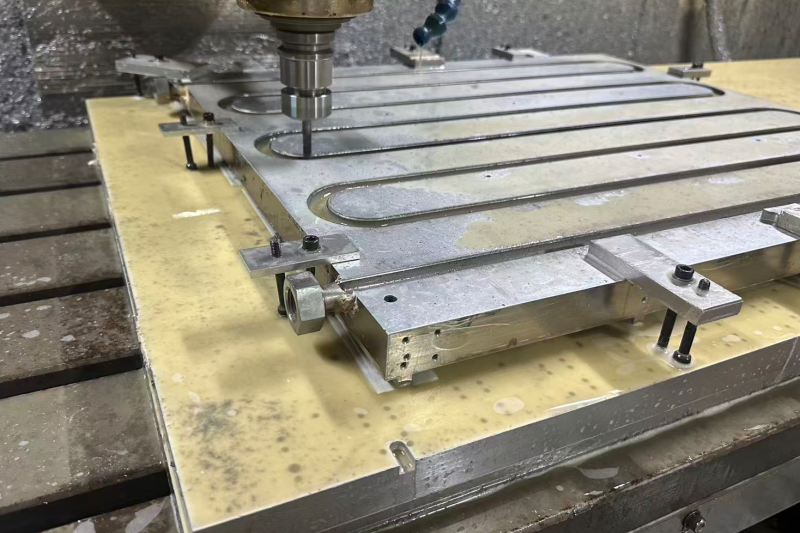
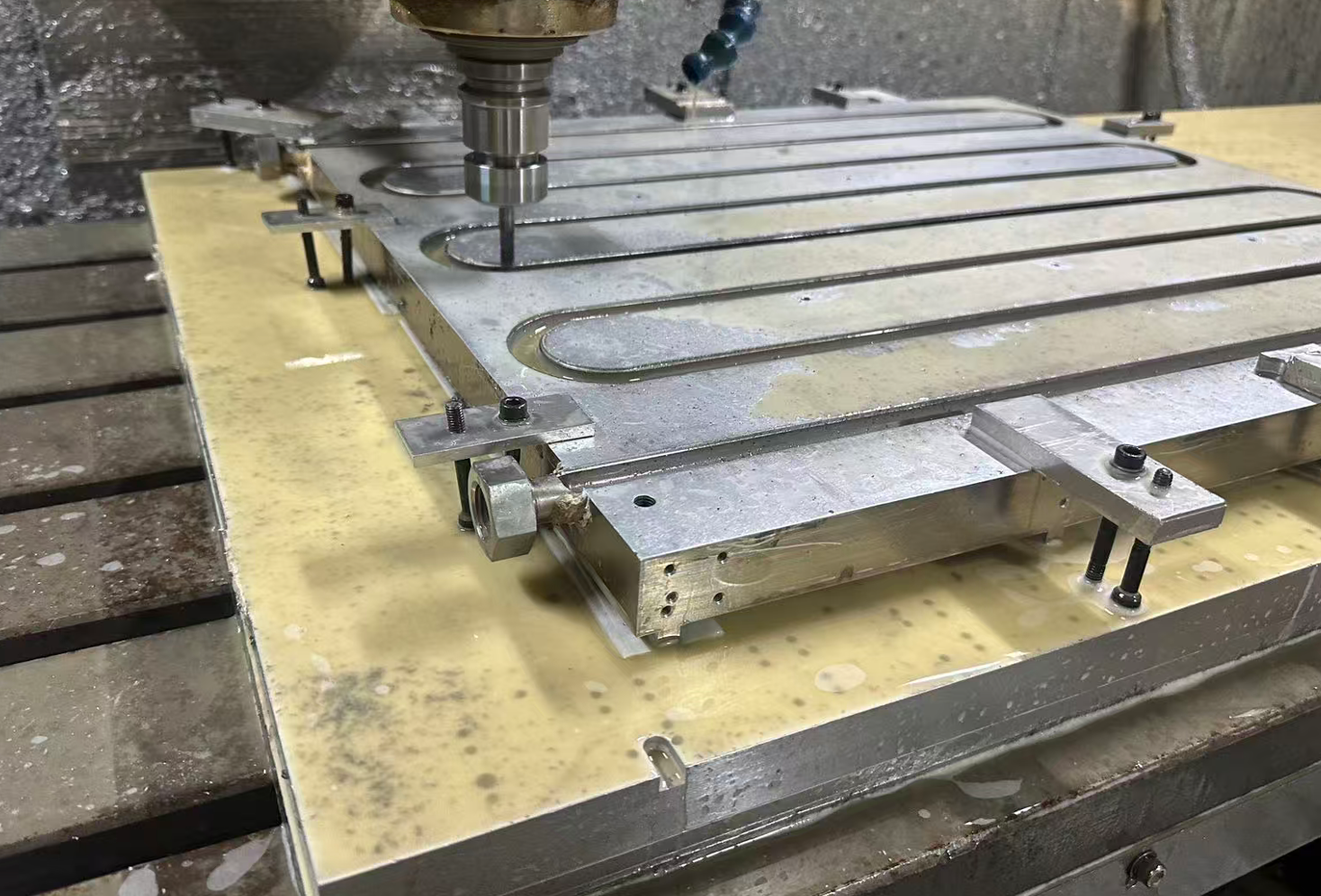
Taking aluminum alloy as the substrate, relying on the excellent basic thermal conductivity and lightweight advantages of aluminum, we process U-shaped grooves completely matching the Φ12mm stainless steel tubes on the aluminum substrate through CNC precision milling, and embed the stainless steel flow channel into the grooves, forming a composite structure of “aluminum substrate heat dissipation + stainless steel flow channel corrosion resistance”.
The exclusive advantages of this structure: it not only retains the characteristics of high-efficiency thermal conductivity, easy processing and controllable cost of the aluminum alloy substrate, but also realizes full-process corrosion resistance of the liquid circuit through the stainless steel flow channel, taking into account heat dissipation performance, service durability and production feasibility. Different from the disadvantages of high processing difficulty and high cost of integrated stainless steel liquid cooling plates on the market, it is more suitable for mass production and customer practical application.
3 Core Self-Developed Processes: Overcoming Stress Deformation and Forming Problems
Stainless steel and aluminum are dissimilar metals, with great differences in elastic modulus and thermal expansion coefficient. The residual stress of aluminum parts after processing and the inherent elasticity of stainless steel will directly lead to severe deformation during product forming. At the same time, the bonding gap of dissimilar metals will generate contact thermal resistance and affect heat dissipation efficiency. In response to these common industrial problems, we have formed a unique three-step forming control process, which is completely optimized from practical production without copying any general industrial schemes.
1 )First Annealing and Shaping: Eliminating Processing Stress of Aluminum Substrate After the U-shaped groove of the aluminum substrate is completed by CNC milling, a large amount of residual stress will be generated inside the aluminum during the cutting process. If the stainless steel tube is directly pressed in at this time, the elastic tension of stainless steel and the internal stress of aluminum will interact, causing direct warping and concave-convex deformation of the substrate, and the product flatness will be completely unqualified.
Our Exclusive Treatment Scheme:The CNC-grooved aluminum substrate is directly placed in a high-temperature furnace for constant temperature annealing at 350℃ to accurately release the cutting residual stress inside the aluminum and avoid deformation caused by subsequent release of internal stress. After annealing, the aluminum substrate is immediately subjected to exclusive mechanical shaping to correct slight deformation generated during annealing, ensuring that the flatness of the aluminum substrate and the position accuracy of the groove are fully qualified, preparing for subsequent tube embedding and eliminating hidden dangers of stress deformation from the first step.
2) Solder Paste Welding Instead of Epoxy Filling + Secondary Shaping: Exclusive Thermal Conductive Bonding Scheme
n the industry, embedded tube liquid cooling plates generally use epoxy resin to fill the groove gap to fix the tube and the substrate. However, epoxy resin has an extremely low thermal conductivity, which will form a thermal insulation layer between the stainless steel tube and the aluminum substrate, directly leading to a sharp decline in heat dissipation efficiency, which is a fatal defect of the general industrial scheme.
Our Exclusive Process Optimization:
2-1. Completely abandon epoxy resin filling, and conduct tin-nickel plating pretreatment on the inner wall of the aluminum substrate groove in advance to improve the welding adhesion of dissimilar metals and eliminate welding gaps;
2-2. Precisely press the first-shaped stainless steel tube into the U-shaped groove, and fill high thermal conductivity solder paste in the groove gap to achieve tight bonding between the stainless steel tube and the aluminum substrate;
2-3. Adopt low-temperature baking process at 180-200℃ to melt the solder paste and fully fill all gaps. After cooling, firm welding between the stainless steel tube and the aluminum substrate is realized, completely eliminating contact thermal resistance and ensuring efficient heat conduction. However, this process brings a new problem: low-temperature baking is equivalent to secondary heat treatment of the aluminum substrate, the previously released stress by annealing will recur, and secondary deformation will inevitably occur after product welding. In response to the problem derived from this self-developed process, we are simultaneously equipped with a secondary exclusive shaping process. After the solder paste welding is cooled, the liquid cooling plate is precisely shaped to correct the deformation caused by thermal stress, ensuring that the overall size and flatness of the product meet the design requirements.
3 )Exclusive CNC Finishing of Hardened Materials: Tool and Process Adaptation After Quenching Phase Transformation
After two times of annealing and baking heat treatment, the liquid cooling plate undergoes a rare material property change in the industry: during repeated heat treatment, the aluminum and stainless steel tubes virtually complete the quenching process, and the overall material hardness is greatly improved, far higher than that of conventional aluminum and stainless steel parts. At this time, processing with conventional CNC tools will cause a series of problems such as fast tool wear, large processing size deviation, tool breakage and unqualified surface roughness.
Our Exclusive Solution:According to the material properties after quenching and hardening, conventional processing tools are abandoned, and special high-hardness cemented carbide tools are selected. At the same time, processing parameters such as cutting speed and feed rate are optimized to complete subsequent CNC finishing processes such as appearance finishing, interface processing and mounting hole positioning of the liquid cooling plate, ensuring the final processing accuracy of the product and solving the industrial problem of difficult processing of hardened materials
4 Final Treatment Process: Anodizing and Clean Cleaning
After all forming and finishing processes are completed, we conduct exclusive anodizing treatment on the surface of the aluminum substrate to further improve the corrosion resistance and wear resistance of the aluminum substrate, while avoiding the impact of aluminum surface oxidation on product appearance and service life. Finally, the internal flow channel and external surface of the liquid cooling plate are comprehensively cleaned to completely remove CNC processing debris, solder paste welding slag and heat treatment residual impurities, ensuring unobstructed inside the stainless steel flow channel, avoiding impurity blockage and increased liquid resistance during coolant circulation, and ensuring that the product can be directly put into use after delivery.
5 Summary of Core Advantages of Self-Developed Processes
From design to process, this stainless steel flow channel cold plate is independently developed by us, which is different from all general industrial schemes. The core unique advantages are as follows:
1). Exclusive Working Condition Adaptability: Designed entirely for non-pure water and corrosive coolant working conditions, the stainless steel flow channel achieves zero corrosion and zero leakage, solving customers’ actual use pain points;
2). Exclusive Deformation Control: The exclusive process of two times of annealing + two times of shaping completely solves the problem of stress deformation caused by dissimilar metal bonding and heat treatment, with controllable product forming accuracy;
3). Exclusive Heat Dissipation Performance: Solder paste welding replaces epoxy filling, eliminating contact thermal resistance, and the heat dissipation efficiency is much higher than that of industrial epoxy embedded tube liquid cooling plates; 4. Exclusive Processing Adaptation: Optimize the finishing scheme for quenched and hardened materials, break through the limitations of conventional processing technology, and realize stable mass production of products.
6 Conclusion
The design and R&D of this stainless steel flow channel liquid cooling plate do not copy any existing industrial technology, but completely base on the actual working conditions of customers and the pain points of our own production practice. Through repeated process trial and error and optimization, a unique design logic and production process have been formed. In the current situation of serious homogenization of liquid cooling heat dissipation products, only by taking root in practical applications and independently overcoming technical problems can we create products that truly meet customer needs and have core competitiveness.
The design ideas and process schemes described in this paper are all summarized from our actual production and R&D experience, which can provide exclusive reference ideas for the R&D and production of similar corrosion-resistant liquid cooling plate products, and also lay a technical foundation for the subsequent iterative optimization of large-size liquid cooling plate products under complex working conditions.Should you have any requirements or technical discussions, please feel free to contact us via email: king@kenfatech.com