
Abstract
Friction Stir Welding Manufacturing Heat Sink.High-power chips in industrial control, new energy, and server applications generate extremely high local heat flux, placing stringent demands on heat sink structure and thermal performance. For high-density heat sinks with fin height over 100 mm and fin spacing less than 2 mm, conventional manufacturing processes present prominent technical limitations. The skived fin process fails to form ultra-high and ultra-narrow fin structures due to material ductility and tool travel constraints. The traditional stacked and riveted process cannot machine effective micro corrugations or on dense fin surfaces, resulting in insufficient heat exchange area and poor heat dissipation capacity for high-heat-flux chip cooling. In addition, mechanical riveting only provides physical contact between stacked fins, creating significant interfacial thermal resistance. Long-term thermal cycling and mechanical vibration further cause fin loosening, offset, and continuous thermal performance degradation.
To solve the above engineering problems, this paper proposes a novel T-shaped corrugated fin unit and an integrated manufacturing process using fixture positioning, multi-pass friction stir welding (FSW), and CNC precision finishing. The proposed structure successfully adds reinforced heat transfer microstructures on ultra-dense fins while maintaining high structural rigidity. The step-by-step FSW method realizes full metallurgical bonding of the entire heat sink, completely eliminating interfacial thermal resistance caused by mechanical riveting. The optimized process stably produces high-precision, high-density, high-efficiency heat sinks suitable for high-power chip heat dissipation. The technology exhibits strong engineering practicability and broad industrialization prospects.
1 Introduction
With the continuous upgrade of new energy electronic control systems, industrial control equipment, and high-end servers, the power density of core chips increases rapidly, leading to a sharp rise in local heat flux. Traditional heat sinks with ordinary fin structures can no longer meet the requirements of efficient and stable heat dissipation. At present, mainstream high-performance heat sink designs adopt ultra-high and ultra-dense fin arrangements, with typical structural parameters of fin height above 100 mm and fin spacing below 2 mm, to enlarge the effective heat exchange area and enhance convective heat transfer.
Nevertheless, conventional manufacturing processes cannot balance structural feasibility and thermal performance. The skived fin process relies on plastic deformation of aluminum alloy materials, which is only applicable to low-height and wide-spacing fin structures. When applied to ultra-high and ultra-narrow dense fins, severe stress concentration occurs during processing, causing fin cracking, root fracture, and structural distortion. Insufficient tool operation space also leads to poor dimensional accuracy and extremely low yield.
The stacked riveting process can realize ultra-high and narrow-spacing fin arrangement, but it faces two fatal defects in high-power heat dissipation scenarios. First, conventional machining cannot fabricate effective micro-scale corrugations on the surface of ultra-dense tall fins, which limits the heat exchange area and makes it difficult to dissipate concentrated high heat flux. Second, mechanical riveting only achieves physical extrusion contact without metallurgical bonding. Tiny gaps between fins produce large contact thermal resistance, hindering heat conduction. Under complex working conditions of temperature cycling and vibration, fin displacement and loosening inevitably occur, resulting in continuous attenuation of heat dissipation performance.
In order to break through the technical bottlenecks of traditional processes, this paper designs a T-shaped corrugated fin unit adapted to friction stir welding. By means of precise fixture stacking and multi-boundary FSW integrated forming, full metallurgical combination of the heat sink is realized. The proposed method effectively solves the problems of insufficient heat exchange area, large interfacial thermal resistance, and poor structural stability of traditional products, and significantly improves the overall heat dissipation performance and service reliability of high-density heat sinks.
2 Limitations of Traditional Manufacturing Processes
2.1 Limitations of Skived Fin Process
The skived fin process is widely used in conventional aluminum heat sink production due to its integral forming feature without splicing interfaces and extra thermal resistance. The processing principle is to strip and bend the base material through professional cutters to form an integrated substrate and fin structure.
However, the forming quality is highly restricted by material plasticity and tool stroke. For fins with a height greater than 100 mm and spacing less than 2 mm, the thin and tall fin structure produces extreme stress during skiving. Structural defects such as cracking, root breakage, and torsion are common. Meanwhile, the ultra-narrow spacing greatly reduces the working space of the cutter, resulting in unqualified perpendicularity and parallelism of the fin array. The formed fins have poor rigidity and are easily deformed during transportation and assembly, leading to extremely low production yield. Therefore, the skived fin process is completely inapplicable for ultra-high-density and ultra-thin fin heat sinks for high-power cooling.
2.2 Defects of Stacked and Riveted Process
Stacked riveting is the mainstream process for manufacturing ultra-dense fin heat sinks. It prefabricates single fins and forms dense fin arrays through stacking and mechanical compression. Although this process can achieve ultra-high fin height and narrow spacing, it cannot meet the performance requirements of high-heat-flux chip cooling in industrial applications.
First, micro heat transfer structures cannot be processed effectively. For ultra-tall and densely arranged fins, traditional milling and embossing methods cannot produce uniform and effective corrugated or tooth-shaped microstructures. The effective heat dissipation area cannot be further increased, so the heat sink fails to cope with local concentrated high heat flux.
Second, the interfacial thermal resistance is excessively high. Mechanical riveting only provides physical contact pressure without metallurgical fusion. Micro gaps exist between adjacent fins. The air inside the gaps forms huge thermal resistance, blocking heat transfer from fins to the substrate. The actual heat dissipation efficiency is far lower than the theoretical design value.
Third, the structural stability and dimensional consistency are poor. The passive mechanical locking force cannot eliminate structural displacement under long-term vibration and temperature cycling. Fin loosening, warping, and offset frequently occur, causing continuous performance degradation. In addition, multi-layer stacking accumulates positioning errors, resulting in poor flatness and consistency of finished products.
3 Design of Novel T-Shaped Corrugated Fin Structure
Aiming at the defects of insufficient heat exchange area and high thermal resistance of traditional high-density heat sinks, this paper innovatively designs a T-shaped corrugated fin unit structure, which matches the friction stir welding process and realizes high-efficiency heat transfer and high-strength integral forming.
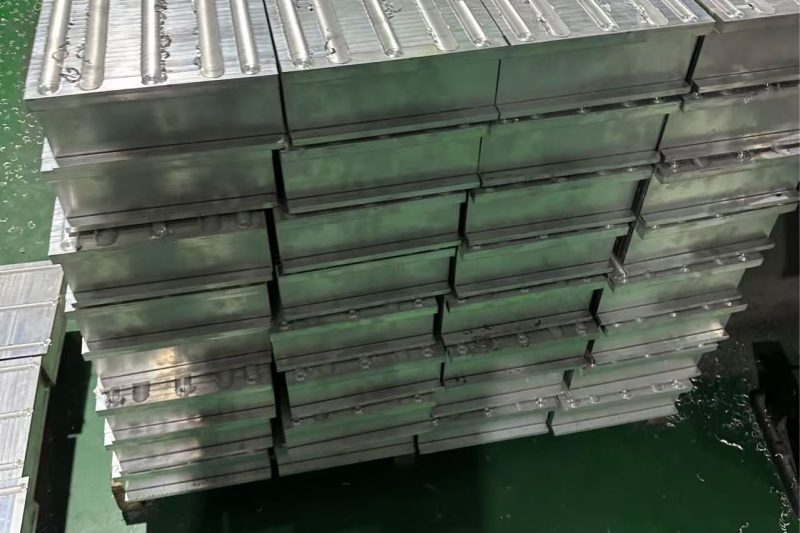
The fin unit consists of two parts: an upper heat exchange main body and a lower T-shaped welding base. The upper part is designed as an ultra-high heat dissipation fin, stably realizing a fin height over 100 mm and a spacing less than 2 mm. Different from traditional flat fins that cannot be micro-processed, the proposed structure adopts customized precision machining to form uniform corrugated and tooth-shaped microstructures on both fin surfaces. The microstructures greatly increase the specific surface area, enhance air convection and turbulent heat transfer, and effectively solve the problem of insufficient heat dissipation capacity for local high-power chip heat flux.
The widened T-shaped base improves the overall rigidity of a single ultra-thin fin and avoids bending and deformation of tall fins. Meanwhile, the regular T-shaped structure provides precise positioning and limiting functions for batch stacking. It ensures uniform fin spacing and excellent perpendicularity, eliminates stacking gaps and dislocation errors, and provides a stable structural foundation and sufficient welding space for subsequent friction stir welding.
According to actual heat dissipation power requirements, multiple T-shaped corrugated fin units are stacked and arranged in order. The self-limiting feature of the T-shaped base ensures a neat and dense fin array, with significantly higher structural accuracy and stability than traditional stacked structures.
4 Integrated Friction Stir Welding Manufacturing Process
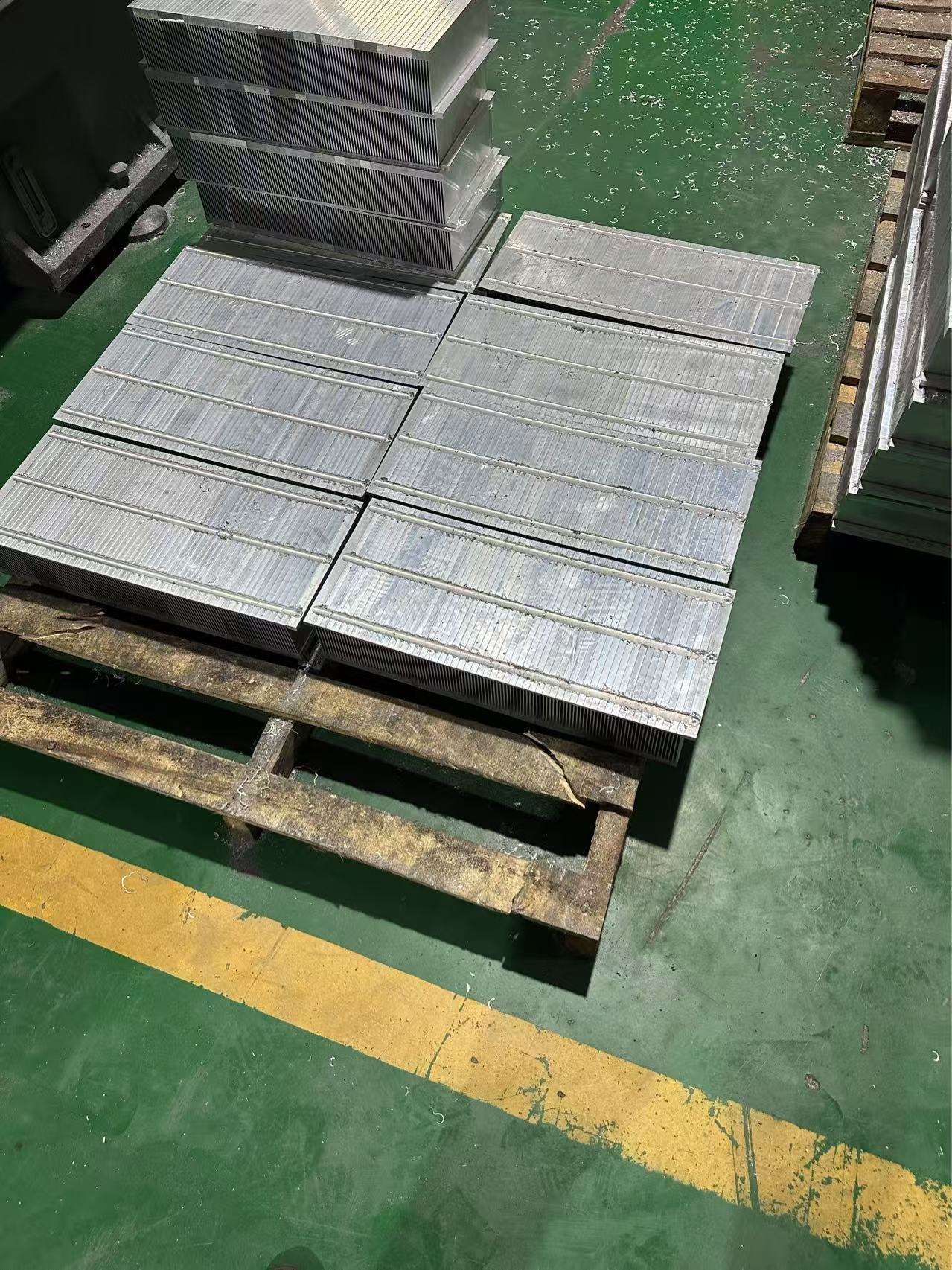
Based on the T-shaped stacked fin structure, this paper adopts an integrated manufacturing process including fixture positioning, multi-pass and multi-boundary friction stir welding, stress relief treatment, and CNC precision finishing. As a solid-phase welding technology, FSW avoids melting defects such as pores and cracks. The welded joint has dense microstructure and excellent thermal conductivity, which can completely replace traditional mechanical riveting, eliminate interfacial thermal resistance, and improve overall structural strength and dimensional accuracy. The complete process flow is as follows: fin unit prefabrication → fixture clamping and positioning → longitudinal middle FSW welding → upper and lower side FSW welding → bottom full-surface FSW sealing → aging stress relief → CNC precision face milling → finished product inspection.
4.1 Fixture Positioning and Clamping
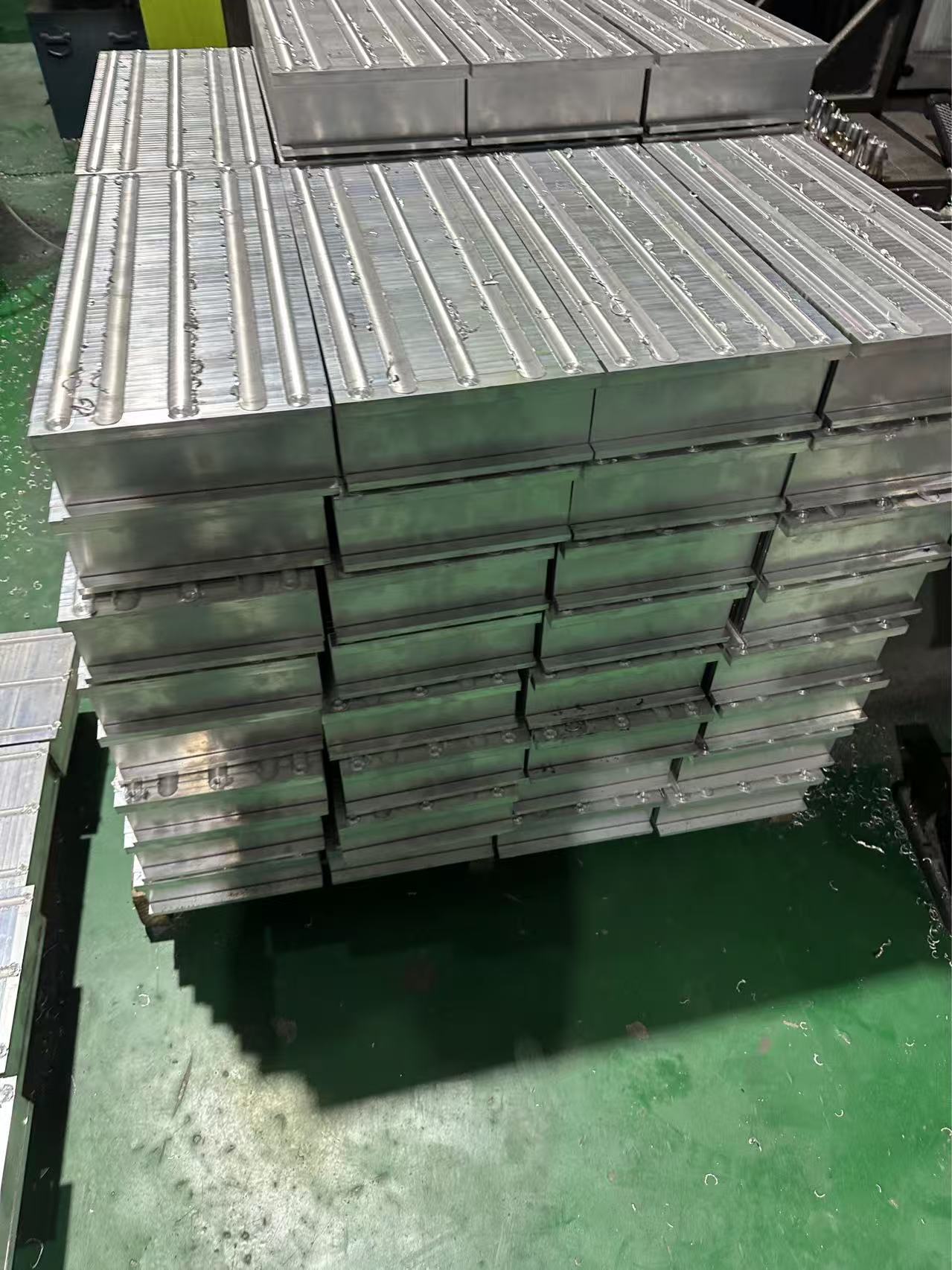
The prefabricated T-shaped corrugated fins are stacked in sequence according to the designed spacing and installed in a customized rigid fixture. Through precise limiting grooves and jacking mechanisms, the fin array is calibrated and compressed integrally. The fixture accurately controls fin perpendicularity, spacing uniformity, and overall flatness, eliminating stacking gaps and cumulative positioning errors. The high-rigidity fixture resists thermal deformation and extrusion displacement during FSW, ensuring structural stability throughout the welding process and guaranteeing high-quality weld formation.
4.2 Multi-Pass and Multi-Boundary Friction Stir Welding
In order to realize omnidirectional locking and gap-free metallurgical bonding of the fin array, a phased and zoned welding strategy is adopted to form a three-dimensional closed locking structure and ensure overall structural integrity.
In the first step, longitudinal middle welding is carried out. A special stirring head adapted to narrow-spacing thick-base fins is used to weld the middle joints of the T-shaped bases. The plastic fusion of aluminum alloy metal initially connects discrete single fins into an integral array, eliminates middle interfacial gaps, forms basic structural rigidity, and prevents dislocation in subsequent welding procedures.
In the second step, upper and lower side locking welding is performed. Transverse FSW is conducted on the upper and lower joints of the base to form a closed loop with the middle weld. The three-sided locking structure thoroughly fixes the relative positions of all fin units, eliminates looseness and offset, realizes zero-gap metallurgical bonding on the side interfaces, and further improves the overall structural strength of the fin array.
In the third step, full bottom surface sealing welding is implemented. The entire bottom substrate of the heat sink is fully welded by FSW. All fin bases are integrally fused to eliminate bottom splicing interfaces completely. The full-surface metallurgical bonding minimizes the bottom thermal resistance, ensures uniform and efficient heat conduction, and fundamentally solves the high thermal resistance defect of mechanical riveting processes. Meanwhile, the integral bottom weld improves surface flatness and reduces welding deformation.
4.3 Post-Welding Precision Machining
After friction stir welding, minor welding deformation, weld reinforcement, and surface unevenness exist on the workpiece. Low-temperature aging treatment is firstly applied to eliminate residual welding stress and avoid subsequent deformation. Then high-precision CNC equipment is used for face milling on the bottom, top, and reference sides of the heat sink to remove weld allowance, correct flatness and perpendicularity errors, and achieve precise dimensional tolerance. The final product is an integrated high-density heat sink with high precision and low internal thermal resistance.
5 Process Innovation and Technical Advantages
5.1 Breaking Traditional Forming Limits and Improving Heat Dissipation Area
The proposed T-shaped fin prefabrication and FSW stacking forming method breaks through the structural limitations of the skived fin process for ultra-high and ultra-narrow fins. It solves the industry difficulty that traditional stacked processes cannot machine micro corrugation and tooth structures on dense tall fins. The innovative process stably produces high-density heat sinks with enhanced micro heat transfer structures, significantly increases the effective heat exchange area, and accurately matches the high heat flux cooling demand of local high-power chips.
5.2 Eliminating Interfacial Thermal Resistance and Improving Thermal Conductivity
Different from the physical contact of mechanical riveting, friction stir welding realizes solid-phase metallurgical bonding between fins and between fins and the substrate. No gaps or air layers exist on the bonding interface, which completely eliminates contact thermal resistance. The continuous integral metal structure greatly improves heat conduction efficiency and stability, providing far better thermal performance than traditional riveted heat sinks.
5.3 Enhancing Structural Rigidity and Working Condition Stability
The three-sided locking plus full-bottom sealing welding forms an integrated monolithic structure. The overall rigidity, deformation resistance, and vibration resistance of the heat sink are significantly improved. Under harsh working conditions of long-term temperature cycling and mechanical vibration, the product maintains stable structural morphology without fin loosening or offset, effectively improving equipment operation stability and service life.
5.4 Improving Dimensional Accuracy and Batch Consistency
With precise fixture positioning, controllable multi-pass welding, and CNC finishing, the key dimensional indicators including fin spacing, flatness, and perpendicularity are accurately controlled. The process effectively reduces batch differences and defect rates, solves the problems of large cumulative errors and poor consistency of traditional riveted products, and meets the precision assembly requirements of high-end electronic equipment.
6 Conclusion
Aiming at the practical engineering problems of traditional high-density heat sink manufacturing, including difficult ultra-dense forming, unavailable micro heat transfer structures, insufficient heat exchange area, high interfacial thermal resistance, and poor structural stability, this paper presents an integrated manufacturing technology combining T-shaped corrugated fin structure design and multi-pass friction stir welding. The proposed method avoids the structural bottleneck of the skived fin process and overcomes the thermal and structural defects of stacked riveting processes.
The optimized process can stably manufacture high-density heat sinks with fin height over 100 mm, fin spacing less than 2 mm, and reinforced micro heat transfer structures. It realizes full metallurgical integration of the heat sink, completely eliminates contact thermal resistance, and greatly improves structural strength and dimensional accuracy. The technology is highly practical and suitable for mass production, with broad application prospects in new energy, industrial control, and high-precision electronic high-power heat dissipation scenarios.