Liquid Cold Plate Connector Selection and Application Guide
Double Ferrule Connectors: Core Leak-Proof Connection Tech for Liquid Cooling Plate Systems
Liquid cooling has become the mainstream thermal control solution for energy storage cabinets, new energy vehicle power batteries and high-load industrial cooling equipment. The stable operation of the entire heat dissipation system largely hinges on the connection reliability of liquid cooling pipelines, and the end connector design is the key core that determines the overall anti-leakage performance.
In actual manufacturing and on-site assembly, three mainstream connection forms are widely used in the industry, including threaded compression connectors, barbed hose connectors and double ferrule self-locking connectors. All three types adopt mechanical extrusion sealing design, yet differ greatly in structural design, assembly efficiency and service stability. This article starts from actual application scenarios, compares the practical characteristics of the first two basic connectors in plain terms, and conducts in-depth original analysis on the structural logic, force-bearing mechanism, assembly norms and practical advantages of double ferrule connectors, providing exclusive technical reference for thermal design engineers, production process engineers and after-sales installation personnel in the cooling industry.
Unified Sealing Principle of Removable Liquid Cooling Connectors
All detachable pipeline connectors used for liquid cooling circulation follow the same physical sealing logic without exception. The whole working process is simple and clear: apply external driving force first, push the internal combined parts to produce directional displacement, use displacement pressure to squeeze the contact assembly parts, make the contact surface form micro elastic deformation, and use the deformed metal surface to fill all tiny assembly gaps, so as to completely block the liquid penetration channel and achieve long-term stable sealing effect.
Whether it is the most common manual thread twisting fastening or the integrated locking mode of double ferrules, the core sealing essence never changes. Sustained and stable mechanical compression force can effectively offset the gap deviation caused by thermal expansion and cold contraction of pipelines in long-term alternating high and low temperature environments. Once the compression force is insufficient or uniformly lost, the original sealed state will be broken, and hidden leakage risks will appear in the pipeline loop.
Original In-depth Analysis of Double Ferrule Self-Locking Connectors
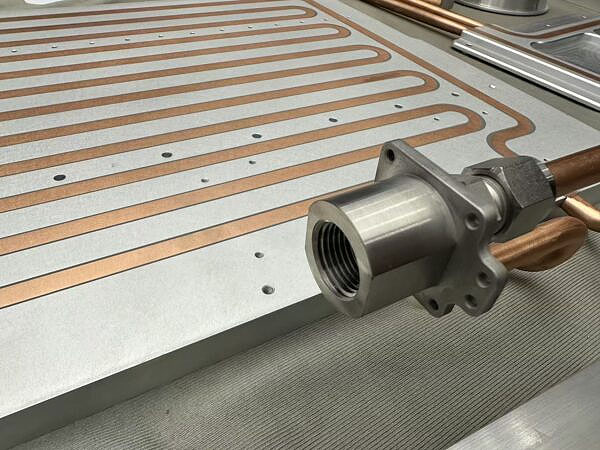
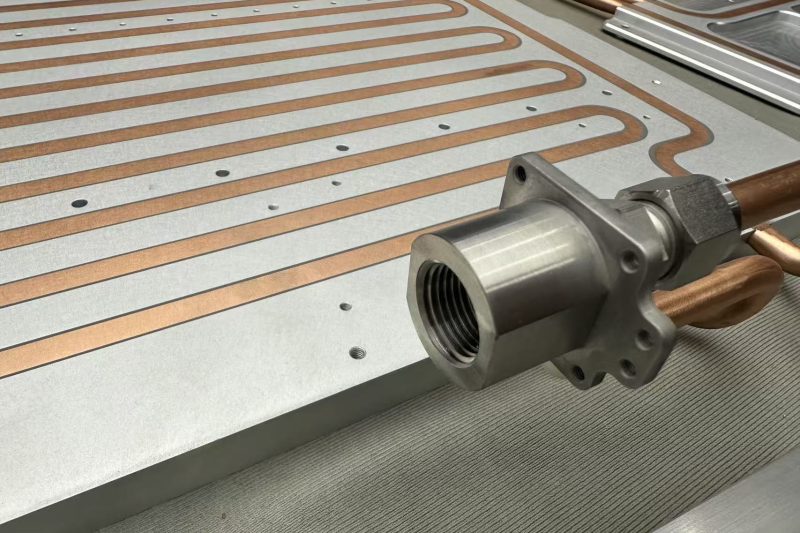
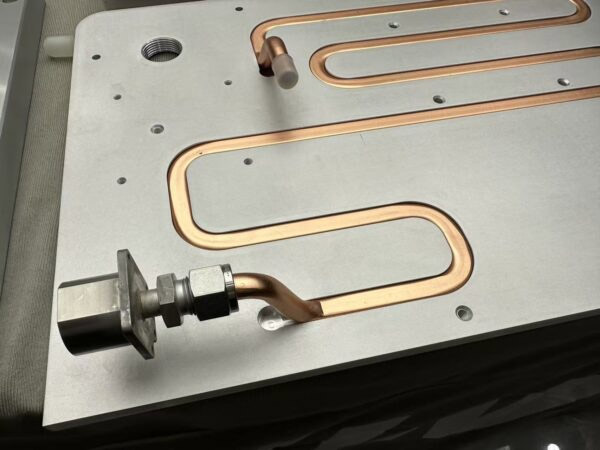
Practical Application Orientation and Independent Structural Layout Double ferrule connectors are specially developed for embedded pipe liquid cooling plates, and are most matched with copper pipes and stainless steel pipes commonly embedded in aluminum alloy cooling plates. Different from traditional connection methods, it completely abandons the secondary turning processing and pipe body welding procedures required by barbed connectors, and realizes one-step quick butt joint installation on site without matching additional split compression nuts.
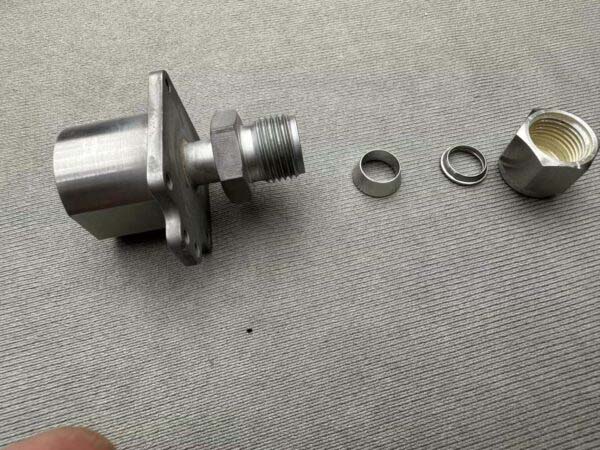
The whole set of connector is composed of four core independent parts: external thread male joint, anti-seize silver-plated locking nut, front tapered ferrule and rear tapered ferrule. The inner wall of the nut is electroplated with silver material, which can greatly reduce thread friction resistance, avoid thread biting and dead locking during repeated disassembly and assembly, and effectively extend the reusable service life of the connector. During installation, only conventional manual wrenches are needed to apply torsion to the nut, and the two groups of tapered ferrules will be forced to shrink inward synchronously, closely fit and lock the outer wall of the liquid cooling pipeline, and complete the whole sealing work without relying on any auxiliary sealing accessories such as silica gel gaskets and raw material tapes.
Core Force-Bearing Logic and Correction of Industry Cognitive Bias
A large number of front-line assembly personnel have formed a single wrong cognition in actual operation, thinking that the double ferrule only plays the most basic pipeline limiting and fixing role, and its sealing effect mainly depends on the matching precision of the joint itself.
In fact, the internal force transmission path of double ferrule connectors is completely consistent with that of threaded compression connectors. Its real working principle is to convert manual twisting torque into stable axial thrust, and use the mutual extrusion between the two groups of ferrules to form controllable metal micro-deformation. All sealing effects are completed by rigid metal surface compression, and there is no difference in force-bearing mechanism and sealing logic from traditional threaded connectors. The so-called ferrule locking is essentially another structural derivative form of mechanical compression sealing.
Standardized Independent Assembly Force Application Steps
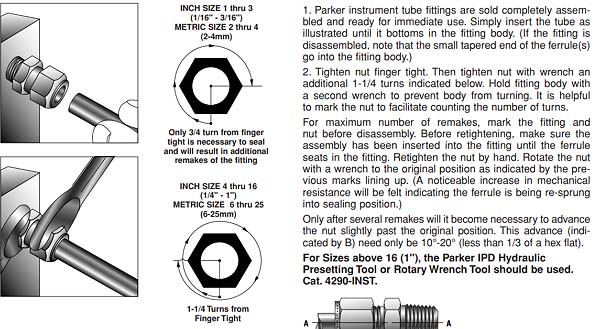
1. Pipeline penetration and positioning: Pass the pre-processed liquid cooling pipeline through the locking nut smoothly in sequence, then sleeve the two groups of front and rear tapered ferrules on the outer wall of the pipeline respectively, and adjust to the reserved installation datum position.
2. Torque input and axial propulsion: Hold the fixed joint main body, use a wrench to slowly twist the locking nut to apply uniform torsion, and the thread structure drives the built-in ferrule group to move forward along the pipeline axis.
3. Mutual extrusion and deformation filling: The inclined surface of the two tapered ferrules contacts and squeezes each other, and gradually produces uniform inward shrinkage force to make the ferrule cling to the pipeline wall, fill all assembly gaps, and cut off all liquid leakage paths.
4. Fixed locking and state confirmation: Stop applying force when reaching the standard assembly torque, keep the overall locking state stable, and avoid random rotation and displacement of parts in subsequent use.
From the perspective of mechanical stress analysis, the combined structure of double ferrules can be regarded as an integrated variable-diameter compression nut. The assembly torque directly controls the shrinkage stroke of the ferrules. Too small torque leads to insufficient shrinkage and residual gaps, while excessive torque will cause irreversible fatigue deformation of the ferrules, damage the pipeline outer wall, and bring hidden dangers of later fracture and liquid leakage. This assembly balance standard is applicable to all mechanical compression liquid cooling connectors.
Exclusive Practical Advantages Summarized from Actual Production
First, it optimizes the production flow of liquid cooling plates, cancels the welding forming process of barbed joints on the pipeline surface, reduces processing procedures and effectively controls production cost and delivery cycle. Second, the shrinkage stroke of the ferrules is fixed, the compression force is evenly distributed around the pipeline, and it can maintain stable sealing performance in long-term high temperature and high pressure working scenes, with far better sealing consistency than soft hose clamping structure. Third, the integrated locking structure has strong vibration resistance and anti-retreat ability. In the equipment operation state with frequent mechanical vibration, it will not automatically loosen and retreat like ordinary threaded nuts, and the overall operation stability is significantly improved.
Comparative Analysis of Practical Leakage Causes of Three Types of Connectors
Threaded compression connectors are most prone to leakage caused by human operation errors. Unstandardized manual twisting leads to uneven compression force, either insufficient fastening resulting in loose gaps, or excessive force causing thread deformation and failure of the compression structure.
Barbed hose connectors rely on hose hoops to clamp the hose for sealing. After long-term fluid impact and temperature change, the fastening force of the hoop nut will gradually attenuate, the fitting tightness between the hose and the joint will decrease, and slow liquid seepage will easily occur at the joint position.
The most common leakage fault of double ferrule connectors comes from incomplete in-place locking and insufficient effective shrinkage stroke. This kind of fault is essentially equivalent to the unfastened state of threaded nuts. The ferrule cannot fully fit the pipeline gap, leaving invisible leakage gaps, which is also the main failure point that needs to be focused on rectified in on-site assembly.
To sum up, the fundamental cause of leakage failure of all cooling plate pipeline connectors is that the mechanical compression force cannot reach the design standard, resulting in incomplete filling of sealing gaps. Formulating unified and standardized assembly operation specifications is the most effective way to reduce pipeline leakage faults.
Industry Application Outlook and Original Production Specification Suggestions
Threaded connectors and barbed hose connectors have low technical threshold and simple structural composition, and are suitable for conventional low-power heat dissipation equipment and ordinary temperature working environments, meeting the basic liquid circulation sealing demand with low matching cost.
As an upgraded optimized connection scheme in the industry, double ferrule connectors abandon redundant external welding processes and adopt built-in integrated compression structure, which perfectly balances on-site assembly efficiency and long-term operation sealing stability, and has gradually become the preferred matching connector for high-end precision liquid cooling equipment and thermal control equipment with strict environmental temperature requirements.
From the perspective of structural iteration, all liquid cooling pipeline connection technologies are developed around mechanical compression sealing principles. The emergence of double ferrule connectors effectively makes up for the defects of traditional joints in assembly efficiency and vibration resistance, and is an important development direction for lightweight, high-efficiency and long-life connection of liquid cooling plates in the future.
In daily batch production and later equipment maintenance, enterprises need to formulate exclusive internal operation standards. Clearly define the standard assembly torque range for threaded and barbed connectors; formulate visual in-place judgment standards for double ferrule connectors, take complete locking, no shaking and no assembly clearance as the qualified acceptance basis. Regularly check the metal elasticity and surface wear of the ferrules, eliminate fatigue failure parts in advance, and comprehensively ensure that the whole set of liquid cooling plate heat dissipation system maintains a safe, stable and leak-free operating state for a long time.