
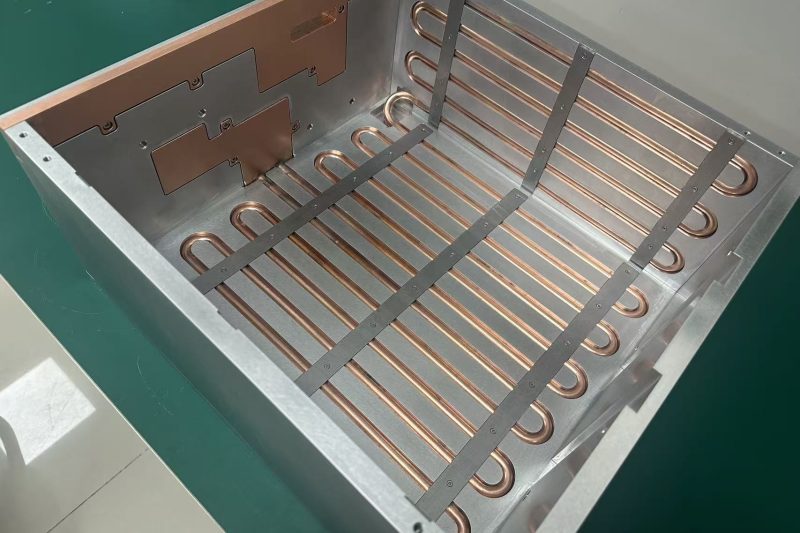
Transformer liquid cooling.In power equipment such as new energy energy storage systems, photovoltaic inverters, high-frequency switching power supplies, and high-power charging piles, inductors and transformers serve as core power components. During high-frequency full-load operation, continuous heat is generated by copper loss in coils and iron loss in magnetic cores. With the continuous improvement of equipment power density in the industry, traditional air cooling and conventional profile heat sinks can no longer match the heat dissipation demands of upgraded equipment. Long-term local heat accumulation and excessive temperature rise will accelerate insulation aging, increase operating noise, reduce overall efficiency, and seriously affect the stability and service life of power equipment.
Aiming at the practical pain points of high-power inductors and transformers, including closed installation, concentrated heat generation and uneven heat dissipation, KENFA TECH has developed an assembled embedded copper tube liquid cooling box structure based on years of practical experience in industrial thermal management. Different from the common single-sided bonded liquid cooling plates in the industry, this product is formed by assembling and sealing multiple aluminum plates. The fully enclosed box can completely wrap and install the inductor and transformer, realizing all-round fitted heat dissipation and effectively solving the problems of insufficient heat exchange area and uneven temperature distribution of traditional heat dissipation solutions.
1. Bottlenecks of Traditional Transformer Heat Dissipation Solutions
At present, most medium and high-power transformers in the industry adopt combined heat dissipation methods including external aluminum shell heat dissipation, single-bottom cooling plate bonding and forced air convection, which have obvious deficiencies in practical application. These solutions only rely on the single bottom contact surface for heat conduction, failing to quickly export heat from coil side walls and the upper part of magnetic cores, resulting in high overall thermal resistance and large vertical temperature difference. In addition, heat conduction relying on thermal interface materials will further increase contact thermal resistance due to multi-layer superposition, causing temperature overshoot under long-term high-load operation. Moreover, open air cooling structures have limited dustproof, moistureproof and insulation performance, and cannot adapt to complex working conditions such as outdoor and energy storage scenarios. Fully enclosed installation will form internal heat accumulation dead zones, making it difficult to balance heat dissipation efficiency and equipment operational reliability.
2. Structural Design of KENFA TECH Custom Assembled Liquid Cooling Box
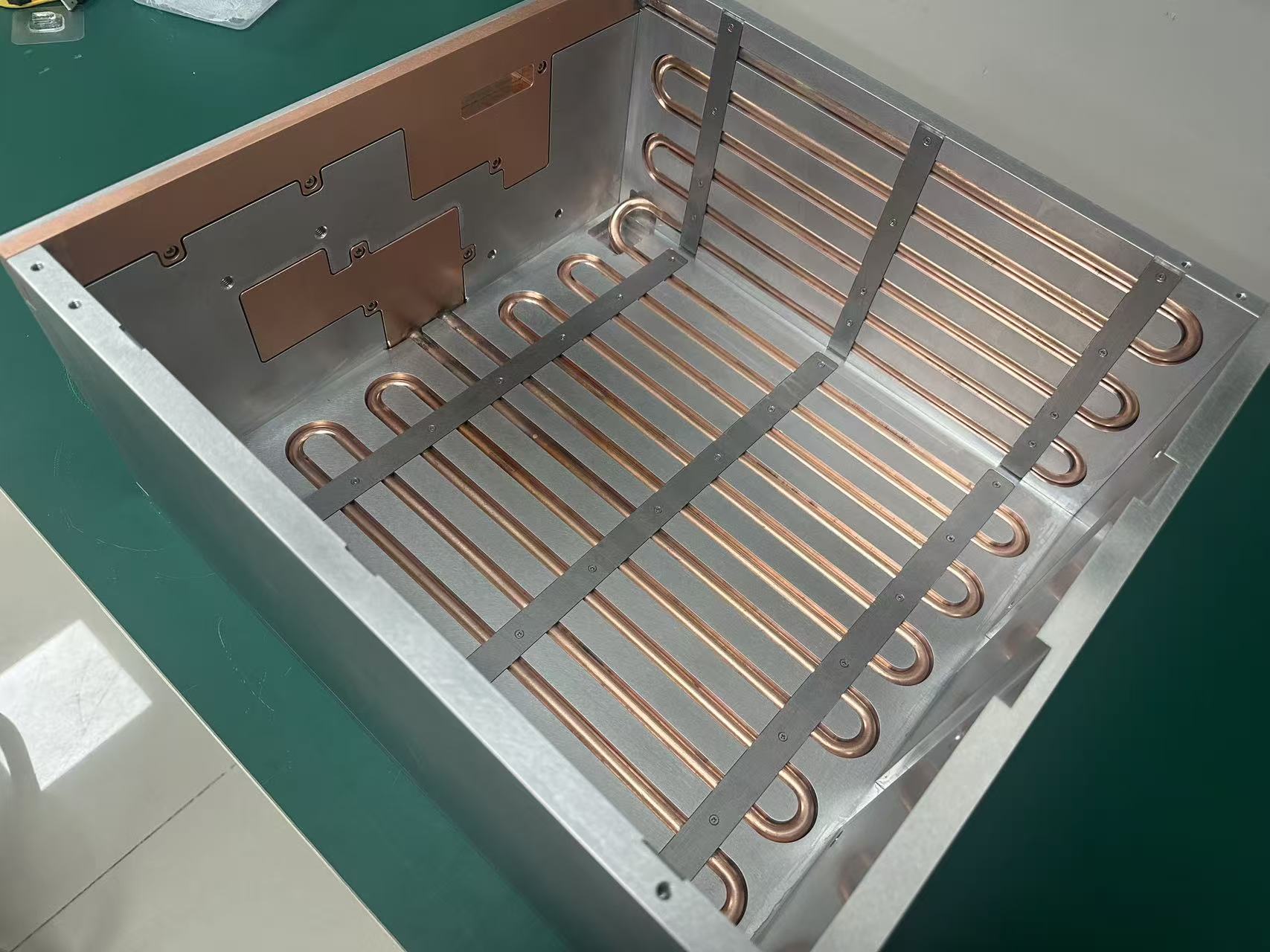
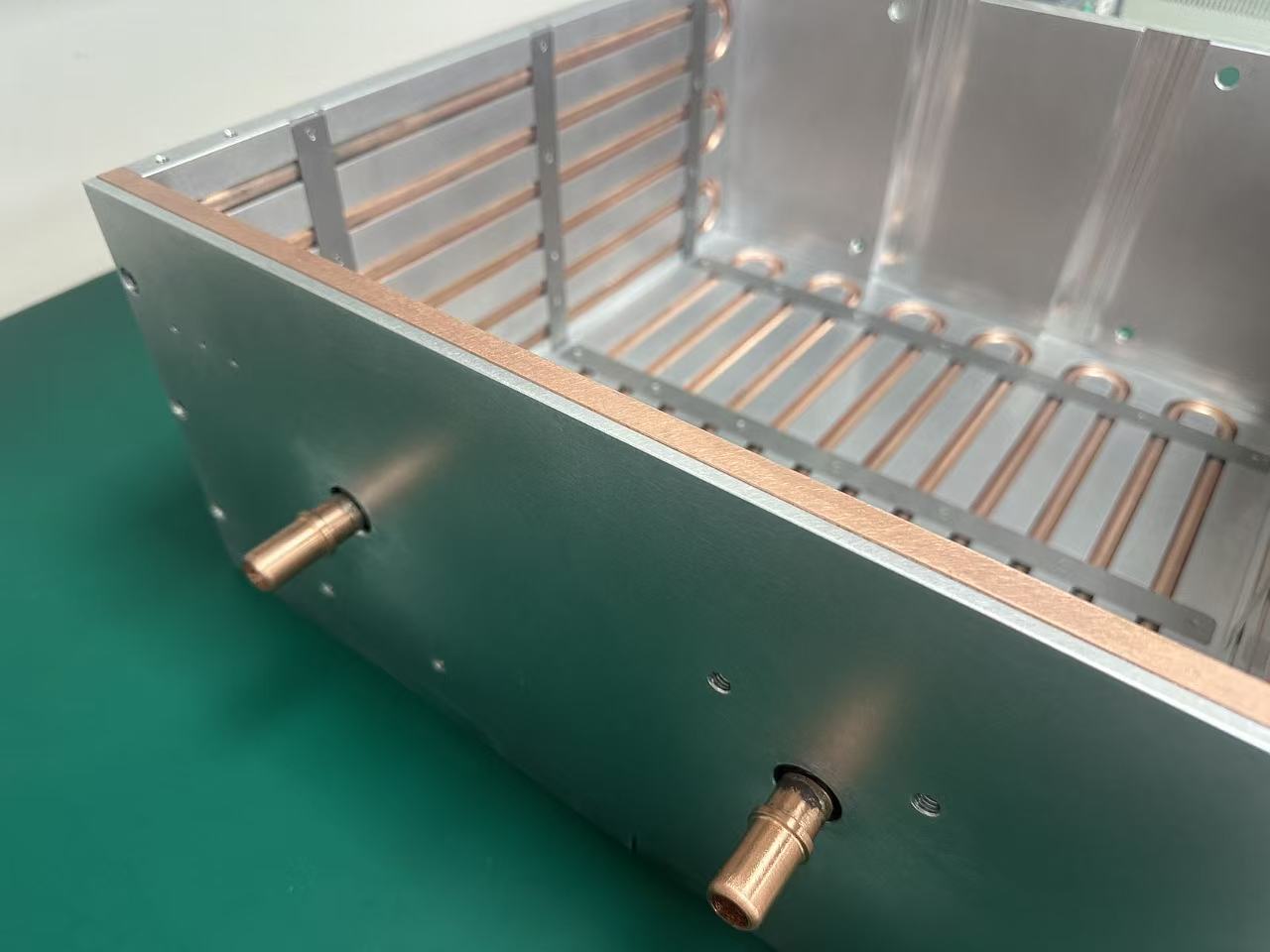
Copper tubed cold plate,The liquid cooling box adopts a modular assembly process with five aluminum plates, including a top plate, a bottom plate and surrounding side plates for precise assembly and sealing. It features high structural strength, good sealing performance and stable deformation resistance. Compared with integral forming structures, the assembled design has higher flexibility, which can be quickly customized according to different sizes of inductors and transformers. It supports mass production with convenient processing, high assembly tolerance and excellent industrial batch applicability.
The interior of the box adopts a dual-tube parallel surrounding heat exchange structure, equipped with two high-precision copper tubes with a diameter of 10 mm. The dual copper tubes are symmetrically arranged and circulate synchronously, with flow channels evenly distributed in the core area of the cavity, fully covering the main heat-generating parts of the transformer. This structure completely avoids the problems of incomplete coverage and unilateral heat exchange deviation of single-channel solutions. Verified by fluid simulation and actual thermal load calculation, the theoretical design flow rate of the pipeline system reaches 15 L/min. The sufficient and stable circulating flow can quickly take away concentrated heat generated under full-load operation and maintain stable heat dissipation performance under long-term high-power working conditions. Compared with conventional machined aluminum flow channels, embedded copper tubes have higher pressure resistance and corrosion resistance, eliminating hidden dangers such as pipeline leakage and bulging, and adapting to 7×24-hour continuous industrial operation.
3. Overall Heat Dissipation Working Principle
The entire thermal management system adopts a composite heat dissipation logic of fully enclosed wrapping, glue-filling uniform temperature and dual-channel liquid cooling circulation. The high-power inductor and transformer are integrally fixed inside the sealed liquid cooling box, and the internal dual 10 mm parallel copper tubes form an independent closed-loop coolant circulation circuit. After assembly and positioning, vacuum glue filling is carried out inside the cavity. The thermally conductive glue completely fills all gaps between transformer coils, magnetic cores and the cavity, thoroughly eliminates internal air insulation layers, and minimizes interface contact thermal resistance.
Heat generated by copper loss and iron loss of the transformer is quickly and evenly transferred to the inner wall of the aluminum box and the embedded copper tube wall through the fully filled thermally conductive glue. The circulating coolant at a flow rate of 15 L/min continuously takes away the heat and completes heat exchange through an external water chiller, forming a closed-loop heat dissipation system. This working method rapidly dissipates concentrated heat sources, eliminates local hot spots fundamentally, and realizes precise and uniform temperature control of the entire transformer.
4. Core Process and Technical Advantages
1. Modular structure with five assembled aluminum plates: Abandoning the high-cost and low-adaptability integral forming process, the precision assembled sealing structure features adjustable size and wide compatibility with various high-power inductors and transformers. It realizes controllable mass production cost and high assembly efficiency, with structural rigidity meeting industrial equipment installation standards.
2. Dual copper tube parallel flow equalization heat exchange: The symmetric surrounding layout of dual Φ10 mm copper tubes matched with a standard 15 L/min design flow ensures uniform flow field distribution and full heat exchange coverage without dead zones. Balanced flow distribution completely improves the common industrial problems of large temperature difference and severe local heat accumulation in single-channel heat dissipation, and greatly enhances overall heat dissipation uniformity.
3. Vacuum full-glue thermal conduction process: The gap-free vacuum glue filling process forms a seamless thermal conduction structure between the transformer heat source, liquid cooling box and heat exchange pipeline with extremely low overall thermal resistance. It effectively balances the working temperature of coils and magnetic cores, reduces overall temperature difference, significantly improves high-temperature howling and power attenuation of transformers, and enhances equipment operation stability.
4. High-reliability fully enclosed design: The fully sealed cavity structure supports silent operation without fan assistance. It has excellent dustproof, moistureproof, insulating and anti-electromagnetic interference capabilities, perfectly adapting to complex industrial scenarios such as new energy storage, photovoltaic inverters and outdoor charging piles with strong environmental adaptability.
5. Application Scenarios and Practical Value
This embedded copper tube parallel liquid cooling box is mainly applicable to 3kW–50kW high-power PFC inductors, high-frequency switching transformers, energy storage isolation transformers and other high-heat power devices. Verified by actual tests, compared with traditional air cooling and single-sided bonded cooling solutions, this structure reduces the overall temperature rise of equipment by 40%–60% and greatly narrows the overall temperature difference. It thoroughly solves the overheating problem of equipment under long-term high-power and high-frequency full-load operation, effectively extends the service life of components, and guarantees long-term stable operation of power equipment.
6. Conclusion
Aiming at the common field pain points of high-power inductors and transformers such as closed heat accumulation, uneven heat dissipation and out-of-control temperature rise under full load, KENFA TECH relies on mature industrial thermal management experience to launch a highly reliable, efficient and mass-producible dedicated liquid cooling solution. Adopting a five-plate assembled sealing structure, dual Φ10 mm copper tube parallel flow equalization design, 15 L/min accurate flow matching and vacuum glue filling uniform temperature process, this structure features uniform heat exchange and ultra-low thermal resistance. It effectively breaks the heat dissipation bottleneck of high-power power devices and provides solid thermal management technical support for the miniaturization, high power density and long-life upgrading of new energy storage, photovoltaic inversion, high-power charging piles and industrial high-frequency power supplies.