Abstract
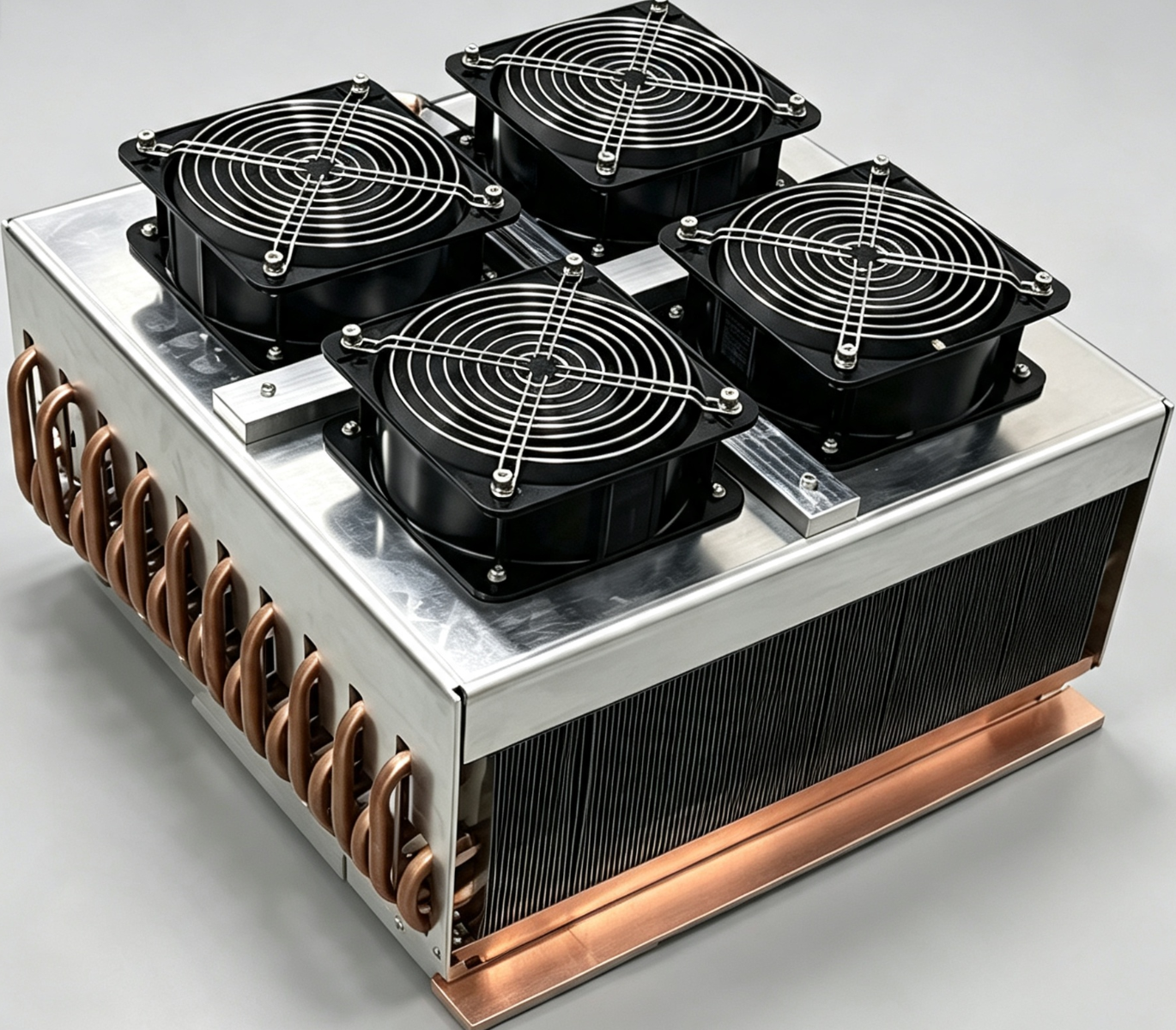
A heat pipe heat sink is developed to address the high heat flux cooling challenge of a 4000W high-power LED searchlight. The overall dimension of the radiator is 350mm×350mm×120mm, equipped with 40 pieces of Φ9.5 mm heat pipes. A 12 mm thick copper base plate is adopted as the heat carrier for the heat source. Solder paste reflow soldering is applied to form tight thermal connection between heat pipes, base plate and fins. Forced air cooling is realized by three Sanyo 9038 axial fans operating at 5500 rpm. Thermal simulation and experimental measurement show that the LED temperature can be steadily maintained at 67.5 ℃ under an ambient temperature of 35 ℃, which meets the long-term reliable operating temperature requirement of high-power LEDs. This solution provides design references for thermal management systems of kilowatt-level outdoor high-power LED lighting sources.
Keywords: High-power LED; 4000W searchlight; heat pipe heat sink; copper base plate; forced air cooling; solder paste welding
1 Introduction
With the development of long-distance searchlighting and special lighting industries, the power of LED light sources keeps increasing, and 4000W high-power LED searchlights have been widely adopted. Approximately 65% of the electric power consumed by high-power LEDs is converted into heat during operation. If heat cannot be dissipated rapidly, the temperature of LED chips rises sharply, causing aggravated light attenuation, shortened service life, and even permanent burnout of LED beads in severe cases.
Traditional integral extruded aluminum heat sinks feature heavy weight and poor temperature uniformity. Simple copper plates cannot offer sufficient convection area to satisfy the heat dissipation demand under 4000W high thermal load. Heat pipes possess ultra-high equivalent thermal conductivity, which can rapidly transfer concentrated local heat to the entire fin area. In this paper, a forced air-cooled heat pipe radiator with thick copper base and multi-heat pipe array is designed. Solder paste welding is adopted to reduce interfacial thermal resistance. Combined with forced convection enhanced by fans, stable temperature control of LEDs is realized.
2 Overall Scheme Design of Heat Sink
2.1 Design Input Parameters
1. Light source power: 4000W LED searchlight
2. Ambient temperature: Ta=35 ℃
3. Target LED temperature: Tc=67.5 ℃
4. Overall boundary dimension of heat sink: 350mm × 350mm × 120mm
5. Cooling method: Heat pipe + fin forced air cooling
6. Heat source contact surface: 12 mm thick copper base plate
7. Heat pipe specification: Φ9.5 mm circular heat pipe, quantity: 40 pcs
8. Fan configuration: Sanyo 9038 axial fan, rotating speed: 5500 rpm
9. Assembly process: Solder paste welding between heat pipes, copper base plate and cooling fins
2.2 Structural Scheme
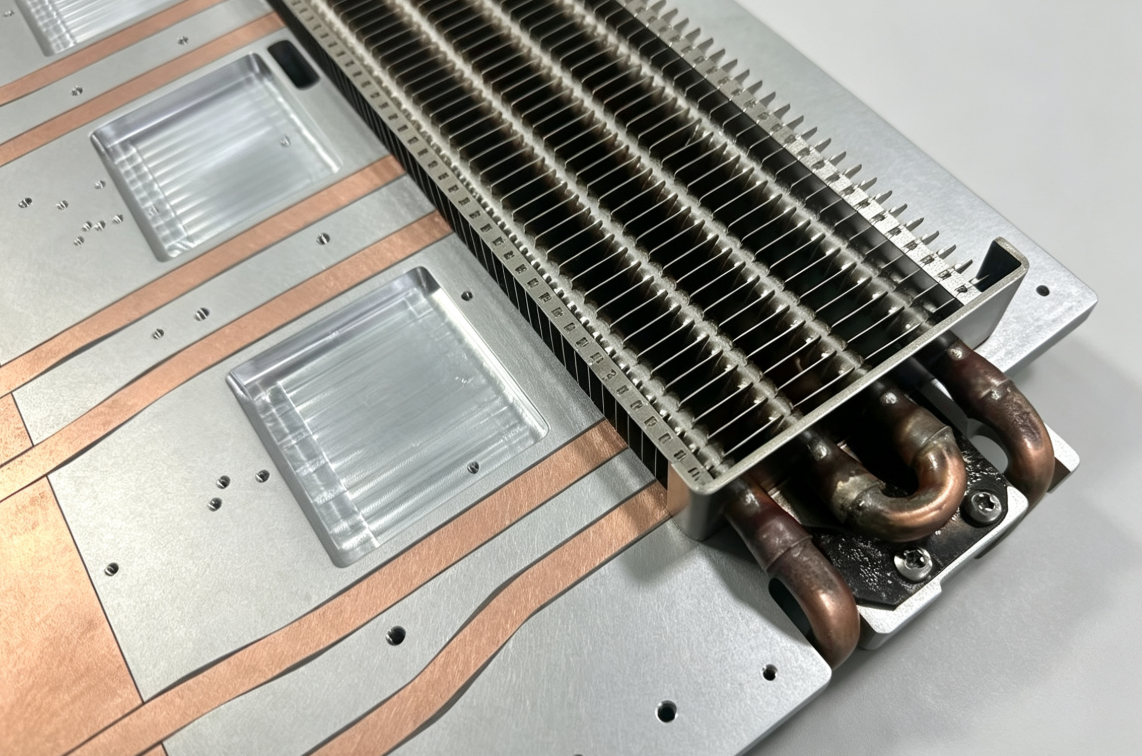
The heat sink consists of four components: copper base plate, heat pipe array, aluminum cooling fins and fan mounting bracket.
1. 12 mm thick copper base plate: Copper owns much higher thermal conductivity than aluminum alloy and outstanding temperature uniformity. It receives concentrated heat from LED modules and avoids local hot spots. Holes are reserved on the base plate for heat pipe installation.
2. Φ9.5 mm heat pipe array (40 pcs): One end of each heat pipe is embedded into the copper base plate, and the other end penetrates aluminum fins. Heat is transferred quickly from the copper base plate to multi-layer aluminum fins via heat pipes to expand heat exchange area.
3. High-density aluminum fins: Fins are welded to heat pipes with solder paste, eliminating air gaps between heat pipes and fins and lowering contact thermal resistance.
4. Sanyo 9038 high-speed fans: High-speed fans at 5500 rpm generate forced airflow sweeping across fin surfaces to carry away heat.
2.3 Selection of Welding Process
Solder paste reflow soldering process is adopted for the radiator. Compared with traditional compression assembly with thermal conductive silicone, solder paste welding forms metallurgical bonding between the outer wall of heat pipes, base plate and fins, which greatly reduces interfacial thermal resistance. No interface aging or thermal performance degradation occurs under long-term high-temperature operation, making it suitable for continuous long-term working scenarios of high-power LEDs.
3 Preliminary Thermal Theoretical Analysis
According to the photoelectric conversion efficiency of LEDs, the thermal load under 4000W input power is approximately 2600W.
Allowable temperature rise: ΔT = 67.5 ℃ – 35 ℃ = 32.5 ℃
Allowable average overall thermal resistance of the system:
Rth = ΔT / Q = 32.5 / 2600 ≈ 0.0125 ℃/W
The total thermal resistance of the cooling system includes four parts:
1. Contact thermal resistance between LED module and copper base plate
2. Conduction thermal resistance of copper base plate
3. Heat conduction resistance of heat pipes + interfacial thermal resistance between heat pipes and fins
4. Convection thermal resistance between fins and air
The overall thermal resistance of the system is controlled within the design threshold by thickening the copper base plate for better temperature uniformity, distributing heat load via multiple heat pipes, reducing interfacial thermal resistance through solder paste welding and enhancing convection with high-speed fans, so as to achieve the target temperature.
4 Simulation and Test Results
Steady-state thermal tests are carried out under constant ambient temperature of 35 ℃:
1. After stable operation for 60 minutes, the temperature of LED base plate stabilizes at 67.5 ℃, meeting the design target.
2. The surface temperature difference of the 12 mm copper base plate is less than 4 ℃. Forty heat pipes effectively share heat load without obvious local hot spots.
3. Comparative test with solid aluminum heat sink of the same size shows that the LED temperature exceeds 82 ℃ under identical conditions, which verifies the advantages of the heat pipe scheme.
4. A 72-hour continuous aging test is conducted. No temperature drift is observed, the solder paste welded interface remains stable without thermal performance degradation.
5 Advantages of the Scheme
1. 12 mm thick copper base plate: Excellent temperature uniformity, matching large-area LED heat sources and preventing local overheating of modules.
2. Array of 40 Φ9.5 mm heat pipes: Abundant heat conduction channels for rapid dispersion of concentrated heat sources, breaking the heat transfer limit of solid metal conduction.
3. Solder paste welding process: Low interfacial thermal resistance with superior long-term reliability compared with press-fit assembly and silicone filling solutions.
4. Sanyo 9038 high-speed fans: High air volume and static pressure, airflow can penetrate dense fin arrays, suitable for outdoor environments with high dust and high temperature.5. Compact dimension of 350×350×120 mm: Realizes heat dissipation for 4000W high power within limited installation space, satisfying assembly constraints of the complete searchlight.
6 Limitations and Optimization Directions
1. The copper base plate brings relatively heavy weight. If weight is a strict indicator, a copper-aluminum composite base plate scheme can be evaluated via simulation for further optimization.
2. High-speed fans at 5500 rpm produce relatively high noise. For low-noise application scenarios, PWM fan speed regulation can be adopted to reduce rotating speed and noise under normal ambient temperature.
3. When used outdoors, dust accumulation on fins will gradually degrade heat dissipation capacity. A simple dust-proof net can be added structurally to facilitate regular maintenance.
7 Conclusion
In this paper, a forced air-cooled heat pipe radiator is designed for a 4000W high-power LED searchlight, with overall dimension of 350mm×350mm×120mm. It adopts a 12 mm thick copper base plate and 40 Φ9.5 mm heat pipes with solder paste welding process, paired with Sanyo 9038 fans at 5500 rpm. Under ambient temperature of 35 ℃, the LED temperature is stably controlled at 67.5 ℃, satisfying the long-term stable operation requirement of high-power LEDs.
The radiator features compact structure, outstanding heat dissipation performance and high long-term reliability. It can fulfill the cooling demand of high-power outdoor LED searchlights and provide reference for thermal management design of similar kilowatt-level special lighting equipment.