1. Introduction
Heat Pipe Heat Sink for Cooling Laser Module.As high-power laser modules are widely adopted in industrial processing, optical communication, and LiDAR systems, continuous operating power and packaging density continue to increase. During normal operation, most input electrical energy is converted into concentrated heat flux rather than optical output. Laser chips are extremely sensitive to operating temperature; even minor thermal accumulation can cause wavelength drift, spot distortion, power attenuation, and reduced equipment stability. In severe cases, sustained overheating will lead to premature aging and permanent failure of laser devices.
Traditional cooling solutions for laser modules mostly rely on stacked assembly structures, combining independent base plates, thermal interface materials, and standard fin heat sinks. This multi-layer stacking inevitably introduces multiple contact interfaces, resulting in high overall thermal resistance and slow heat response. Such structures can only meet low-power operating conditions and struggle to handle the instantaneous high heat flux generated by modern medium-and high-power laser modules. Therefore, developing a low-resistance, high-power, high-uniformity dedicated heat sink has become essential for stable laser system operation.
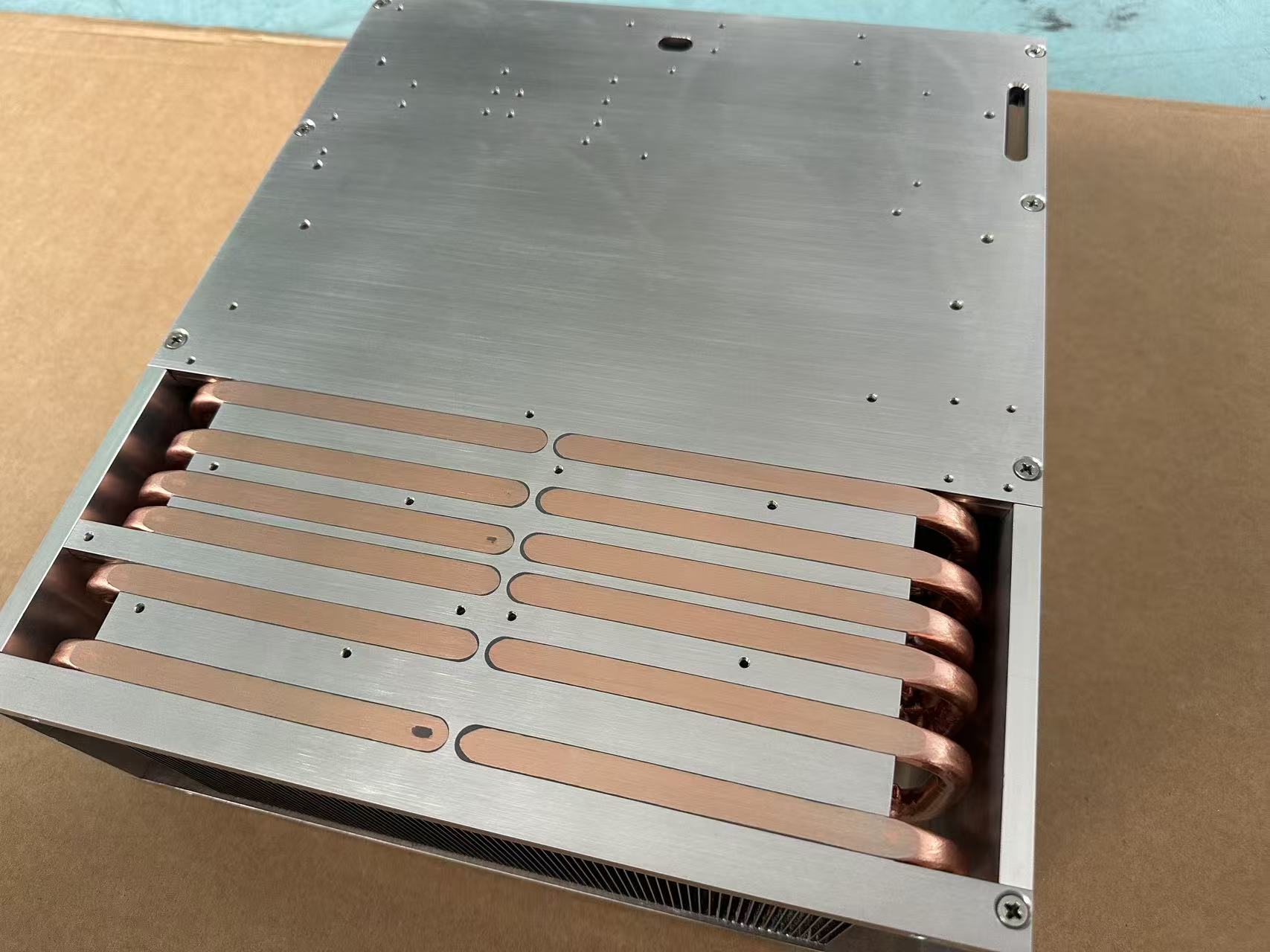
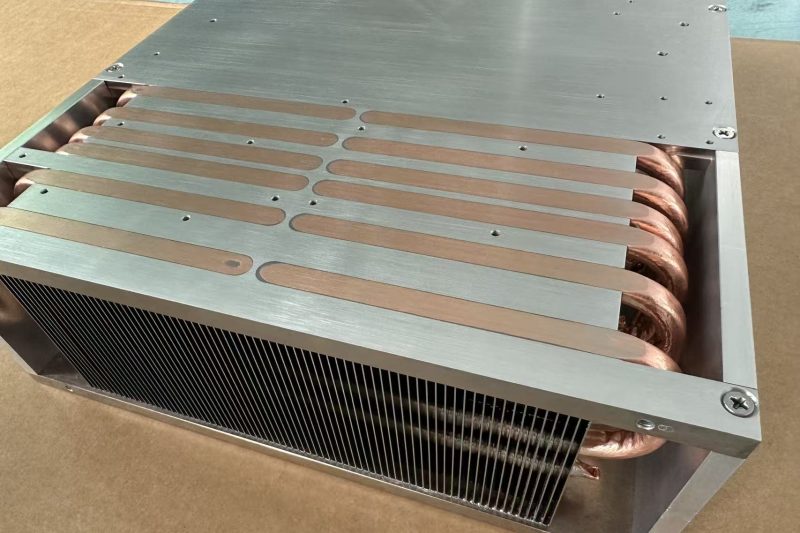
To address the above industry challenges, KENFA TECH proposes an optimized high-power heat pipe heat sink solution for laser module thermal management. The overall radiator dimension is 100 mm × 200 mm × 80 mm. Different from conventional stacked structures, this design adopts a direct heat pipe bonding structure, which greatly shortens the heat conduction path and significantly reduces interface thermal resistance. Equipped with high-power heat pipe arrays and integrated welding processes, the solution achieves efficient and uniform heat dissipation for high-load laser modules.
2. Limitations of Traditional Laser Thermal Management Solutions
In conventional laser heat dissipation systems, the heat transfer path is long and segmented: laser chip heat source → module housing → thermal interface material → aluminum base plate → fin heat sink → ambient air convection. Each contact interface creates additional thermal resistance, making it difficult to transfer concentrated heat out rapidly.
In addition, ordinary solid aluminum base plates exhibit limited lateral thermal conductivity. When facing concentrated point heat sources from laser chips, the base plate cannot evenly spread heat, resulting in obvious hotspots and large temperature differences across the module surface. Long-term uneven temperature distribution severely restricts laser output consistency and shortens the service life of optical components.
It is clear that simply increasing fin area cannot fundamentally solve the thermal bottleneck of high-power laser modules. The core improvement direction lies in optimizing the heat conduction path, reducing interface resistance, and improving overall thermal response speed.
3. Structural Design and Process Innovation of KENFA TECH Laser Heat Sink
Based on years of accumulation in precision thermal management and CNC processing technology, KENFA TECH has developed a dedicated high-power heat pipe integrated heat sink for laser module scenarios. The overall structural size is fixed at 100 mm × 200 mm × 80 mm, which balances installation compatibility and heat dissipation redundancy for mainstream medium-to-high-power laser equipment.
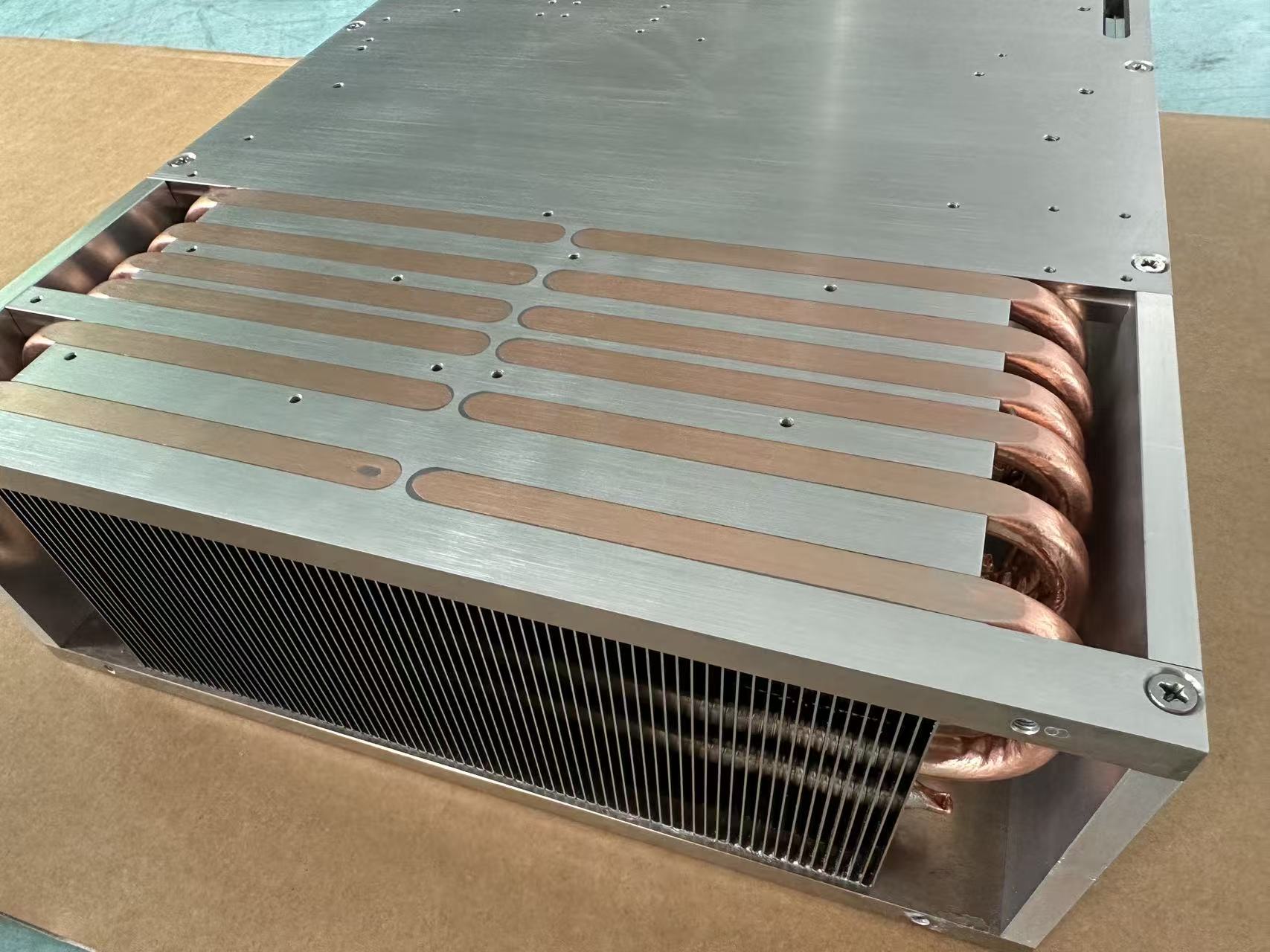
The core thermal conduction unit adopts 10 pieces of Φ10 mm high-purity copper heat pipes. Through internal phase-change heat transfer, each single heat pipe can stably and continuously carry a heat load of 100 W. The entire heat pipe array provides a total effective heat dissipation capacity of 1000 W, fully meeting the full-load continuous heat dissipation requirements of high-power laser modules.
3.1 Direct Heat Pipe Attachment Structure (Low Thermal Resistance Core Design)
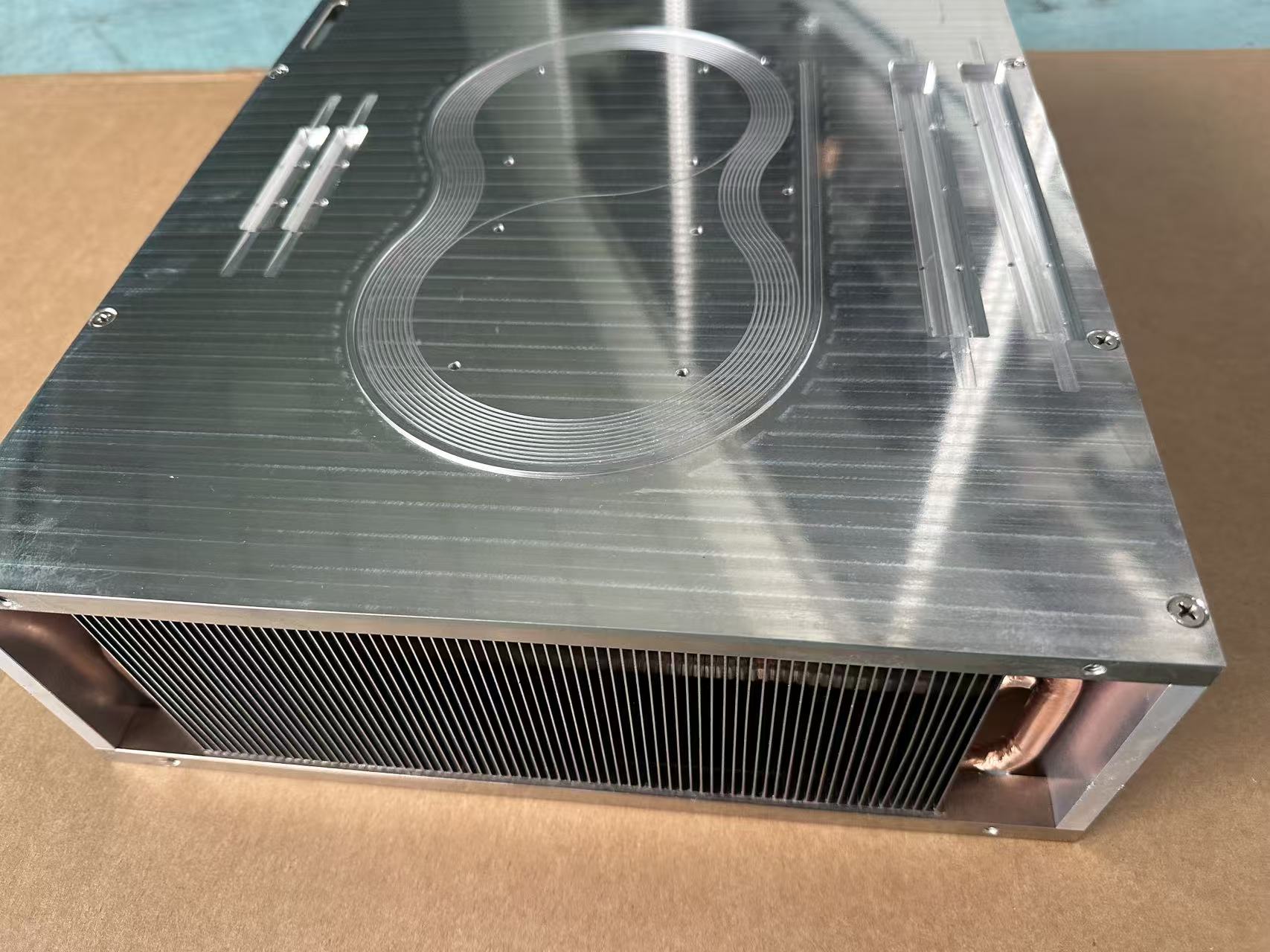
The biggest structural optimization of this solution is the cancellation of redundant intermediate transition layers. The heat pipes are tightly embedded and directly bonded to the inner side of the radiator base, while the outer base surface fits closely with the laser module heat source. This achieves a shortest-path heat conduction mode of “laser heat source — metal base — heat pipe”.
Compared with traditional multi-layer stacked structures, the direct-contact design eliminates multiple interface thermal resistance sources, greatly improves thermal response speed, and avoids heat accumulation inside the laser module during high-power operation.
3.2 Fin-Penetrating Layout + Integral Copper Welding Process
In this solution, all Φ10 mm heat pipes penetrate the entire fin array vertically and are integrally fixed with the base and fins through professional copper welding technology. Traditional heat sink assembly mostly adopts mechanical pressing or interference fitting, which inevitably leaves tiny assembly gaps and forms air insulation layers, increasing contact thermal resistance and attenuating overall heat dissipation performance.KENFA TECH adopts overall welding forming technology to realize seamless bonding between heat pipes, base plate and fins. The interface fitting degree is close to 100%, which completely eliminates assembly gaps. The penetrating heat pipe layout enables the concentrated heat of the laser module to quickly diffuse horizontally and cover the entire fin area, realizing uniform temperature distribution and maximizing the 1000 W heat dissipation potential of the heat pipe array.
4. Working Principle of Low-Resistance High-Efficiency Heat Dissipation
The thermal management logic of the KENFA TECH customized laser heat sink is divided into three core stages:
First, zero-delay heat absorption and low-resistance conduction. The laser module heat source directly contacts the radiator base, and the heat is quickly transmitted to the embedded heat pipe array without intermediate medium loss. The ten high-power heat pipes work in parallel to rapidly divert concentrated heat flux, effectively suppressing hotspot accumulation.
Second, phase-change rapid homogenization. Relying on the high-efficiency vapor-liquid phase-change circulation inside the heat pipes, local high-temperature heat is quickly transferred to the entire fin structure, solving the problem of uneven temperature of traditional solid base plates.Third, large-area convection and stable heat dissipation. The heat evenly distributed on the fin array is continuously dissipated through air convection. With sufficient heat dissipation redundancy, the system can effectively stabilize the operating temperature of the laser module and reduce temperature fluctuation during long-term operation.
5. Technical Advantages and Engineering Value
Compared with conventional laser heat dissipation products on the market, the KENFA TECH direct-bonded heat pipe heat sink has obvious technical advantages in high-power laser scenarios:
(1) Ultra-low thermal resistance and high power redundancy. By canceling multi-layer stacking and adopting integral welding, the overall thermal resistance of the system is reduced by more than 30%. With 10 × Φ10 mm heat pipes supporting a total heat dissipation of 1000 W, it can stably cope with long-term high-load operation of industrial-grade high-power laser modules.
(2) Excellent temperature uniformity. The full-penetration heat pipe array realizes rapid planar heat spreading, eliminates local hotspots of the laser chip, ensures stable laser wavelength and spot quality, and improves the precision consistency of laser equipment.
(3) Compact structure and strong compatibility. The 100 mm × 200 mm × 80 mm integrated structure avoids redundant space occupation. It is compatible with natural convection and forced air cooling conditions, and can be widely adapted to various mainstream laser module installation structures.
(4) High reliability and long service life. The integral welding process avoids loose contact and thermal attenuation caused by long-term vibration. Stable and low-fluctuation temperature operation effectively reduces thermal aging of laser optical devices and improves the overall service life and stability of the equipment.To intuitively reflect the performance advantages and applicable scenarios of the KENFA TECH direct-soldering heat pipe heat sink, this paper sorts out and compares three mainstream laser module thermal management solutions, including traditional stacked heat sinks, the proposed heat pipe air-cooled solution, and liquid cold plate solution. The core parameters, heat dissipation capacity, temperature control level and application limitations are summarized in the table below, which clarifies the technical boundaries and scenario matching of each solution.
|
Thermal Management Solution
|
Effective Heat Dissipation Power
|
Module Temperature Control Accuracy
|
Operating Noise
|
Structural Thermal Resistance
|
Applicable Scenarios
|
Comprehensive Cost
|
|---|---|---|---|---|---|---|
|
Extrusion Heat Sink
|
≤500 W
|
≥60 ℃ (Poor uniformity)
|
Medium-High
|
High (Multi-layer interface superposition)
|
Low-power laser modules, ordinary industrial scenarios with low temperature control requirements
|
Low
|
|
KENFA TECH Direct-Soldering Heat Pipe Heat Sink
|
≤1000 W
|
45–55 ℃ (Excellent uniformity)
|
Medium-Low
|
Low (Reduced by over 30%)
|
Medium and high-power laser modules, mainstream industrial laser processing, optical communication and LiDAR equipment
|
Medium (High cost performance)
|
|
Liquid Cold Plate Cooling Solution
|
≥2000 W
|
≤45 ℃ (Ultra-high precision control)
|
Ultra-low / No fan noise
|
Ultra-low
|
Ultra-high-power laser equipment, low-noise working environment, high-precision constant temperature scenarios
|
High (Support high-load continuous operation)
|
It is worth mentioning that this air-cooled heat pipe solution is highly cost-effective and reliable for laser modules with power within 1000 W and conventional temperature control requirements. However, for extreme operating scenarios where the laser operating power exceeds 2000 W, meanwhile requiring ultra-low noise operation and strict module temperature control below 45 ℃, the air-cooled heat pipe structure can no longer meet the heat dissipation and precision temperature regulation demands. In such high-power, high-precision and low-noise scenarios, liquid cold plates become the optimal thermal management choice. With high specific heat capacity and uniform heat transfer characteristics, liquid cooling systems achieve ultra-stable temperature control, zero fan noise and continuous high-load heat dissipation, perfectly matching the extreme working conditions of high-power laser equipment.
6. Conclusion
Aiming at the practical thermal pain points of high-power laser modules such as high heat flux density, easy hotspot accumulation and poor temperature stability, KENFA TECH develops and optimizes a direct-attached welded heat pipe integrated heat sink. Through structural innovation of direct heat pipe contact and process upgrade of integral fin-penetration welding, the heat conduction path is greatly shortened and the interface thermal resistance is effectively reduced.With a reasonable overall size of 100 mm × 200 mm × 80 mm and a high-power heat pipe array of 1000 W total heat dissipation capacity, the solution achieves efficient heat conduction and uniform temperature control. It solves the thermal bottleneck of traditional laser heat sinks under high-load working conditions, and can provide stable and reliable thermal management support for industrial laser processing, optical communication lasers, LiDAR detection and other precision equipment, possessing high engineering application and popularization value.