
Abstract:
The Huawei-Qualcomm cross-licensing patent deal unlocks next-generation 5G and AI chip innovation. This article explains why high-performance heat sinks and liquid cold plates become critical to release full chip computing power.
1.What Happened
Huawei and Qualcomm recently announced a multi-year, broad patent license agreement. The deal covers cross-licensing of patent portfolios across 5G, computing, artificial intelligence (AI), and networking. In addition, Qualcomm will acquire part of Huawei’s US-region patents in computing, AI, networking and related technology fields.
The transaction still needs regulatory approval before closing. The agreement follows FRAND principles for standard essential patents, and marks a major milestone for global mobile and AI semiconductor ecosystems. Most industry commentary focuses on intellectual property, 5G standards and commercial licensing. However, one critical hardware topic is often overlooked: thermal management.
2. Why Thermal Design Matters
Patent cross-licensing removes IP barriers for chip designers. It allows both companies to iterate newer, higher-performance chips combining 5G communication and AI computing.
More transistors and higher bandwidth bring greater computing capability, but also sharply rising power density. Polar Code is a forward error correction (FEC) coding scheme proposed by Professor Erdal Arikan from Bilkent University in Turkey in 2008. As a linear block code, Polar Code is built on the “Channel Polarization” theory.
Through recursive channel transformation, multiple weak channels are converted into a set of polarized subchannels. Some subchannels approach perfect channels with capacity close to 1, while others become pure noise channels with capacity near 0. During encoding, information bits are allocated to reliable perfect subchannels, and Frozen Bits are placed on low-reliability noise subchannels, achieving transmission efficiency close to the Shannon Limit.
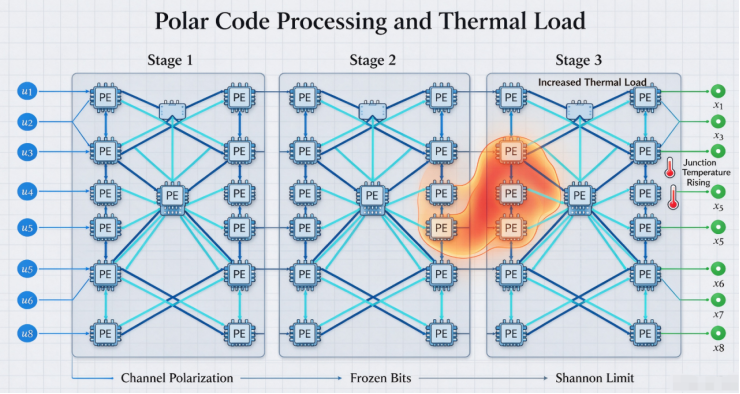
Polar Code is the only constructive coding scheme rigorously proven to reach the Shannon limit over binary discrete memoryless channels. Its encoding and decoding complexity is O(N log N), featuring low latency, high reliability and no error floor. At the 87th 3GPP RAN1 meeting in 2016, Polar Code was selected as the coding scheme for control channels in 5G eMBB, marking its important position in global communication standards.
When baseband chips continuously run Polar Code encoding and decoding operations, numerous hardware computing units are occupied. High thermal power is generated during chip operation, and local hotspots on the chip rise rapidly. Thermal throttling will kick in once junction temperature exceeds design limits. No matter how advanced the IP or communication algorithm is, overheating forces chips to reduce clock speed and sacrifice performance. In short, patents define what chips can calculate; thermal management decides whether chips can run continuously at full load.
3. Engineering Solutions for High Power Chips
To stabilize junction temperature for 5G baseband and AI accelerator chips, thermal engineers adopt two mainstream high-performance solutions: skived fin heat sinks and liquid cold plates.
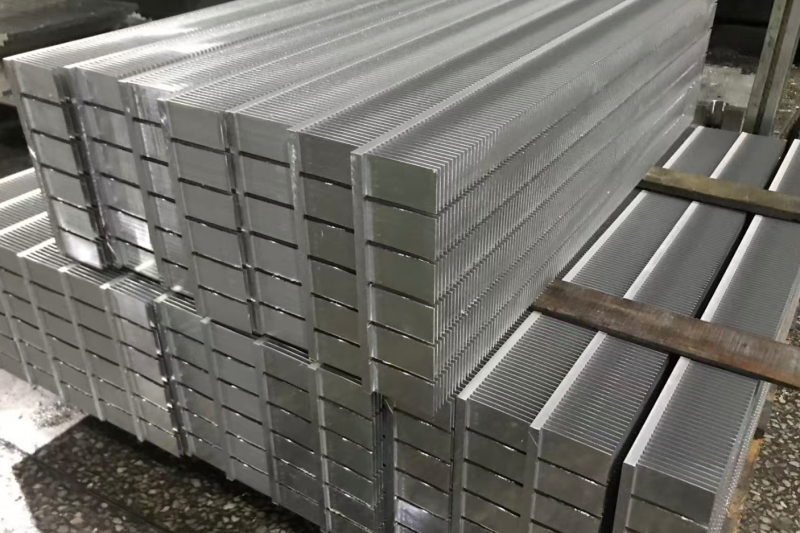
Skived fin heat sinks use precision machining to create ultra-thin, densely packed aluminum fins. Made from 6063-T5 aluminum, this structure maximizes exposed surface area under limited space. It delivers much lower thermal resistance than traditional extruded heat sinks for medium-to-high power devices.
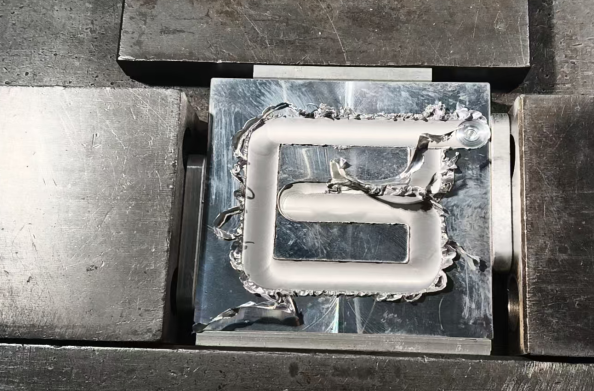
For extreme power density scenarios, liquid cold plates become the preferred option. Liquid flows inside the plate to carry heat away from the chip contact surface. We use friction stir welding and brazing processes to guarantee sealing and structural reliability. Thermal simulation via ANSYS Fluent validates temperature distribution before prototype manufacturing.
4. Comparison of Cooling Solutions
Extruded heat sinks: Low cost, simple structure. Limited fin height and density, suitable for low-power chips under 50W.
Skived fin heat sinks: Medium cost, high fin density. Works well for 80W–300W 5G modules and edge AI chips.
Liquid cold plates: Higher cost, excellent heat transfer capacity. Designed for high-power AI servers and high-density computing racks above 300W.
Choosing the right cooling solution depends on power consumption, available space, ambient temperature and continuous running requirements. One single cooling design cannot fit all chip use cases.
5. Application Scenarios
These thermal solutions are widely deployed in industries accelerated by 5G and AI chip innovation:
-5G communication base stations and customer premise equipment
Edge computing and onboard vehicle AI computing modules
AI server racks and high-density data center hardware
Aerospace and vacuum thermal control systems
Just like the aerospace thermal engineer you communicated with, thermal boundary conditions change drastically between vacuum space and ground air convection. Each application requires custom thermal simulation and mechanical design.
6. FAQ & Closing
Q1: Will this Huawei-Qualcomm patent agreement directly change chip thermal specifications?
A: No. The patent license does not modify chip power or thermal design parameters directly. It speeds up the launch of next-generation high-power chips, which raises higher requirements for thermal dissipation.
Q2: When should we select skived fin heat sinks versus liquid cold plates?
A: Skived fin heat sinks are the preferred choice for compact 5G and edge AI hardware with moderate power. Liquid cold plates are selected for high-wattage AI servers where air cooling cannot meet thermal targets.
If your team develops 5G or AI computing hardware and needs thermal simulation, custom heat sink or cold plate prototyping, our thermal engineering team can support your project from concept to mass production.you can send us email king@kenfatechcom and WhatsApp/Tel:+861392290921