
Overview
When working on high-power thermal designs, we get asked this question all the time: for high heat flux applications, should I pick liquid metal or graphene thermal film?Many hardware teams see the high thermal conductivity value of graphene and assume it outperforms all other TIMs. Some engineers also hear about ultra-low thermal resistance of liquid metal and plan to replace thermal grease directly.But after working on laser modules, optical transceivers and AI board projects, we have run into quite a few real-world issues. Even though both are premium thermal materials, their heat transfer logic and production risks are totally different. This guide is written from a hardware engineering perspective, to help you make the right choice.
Quick definition:
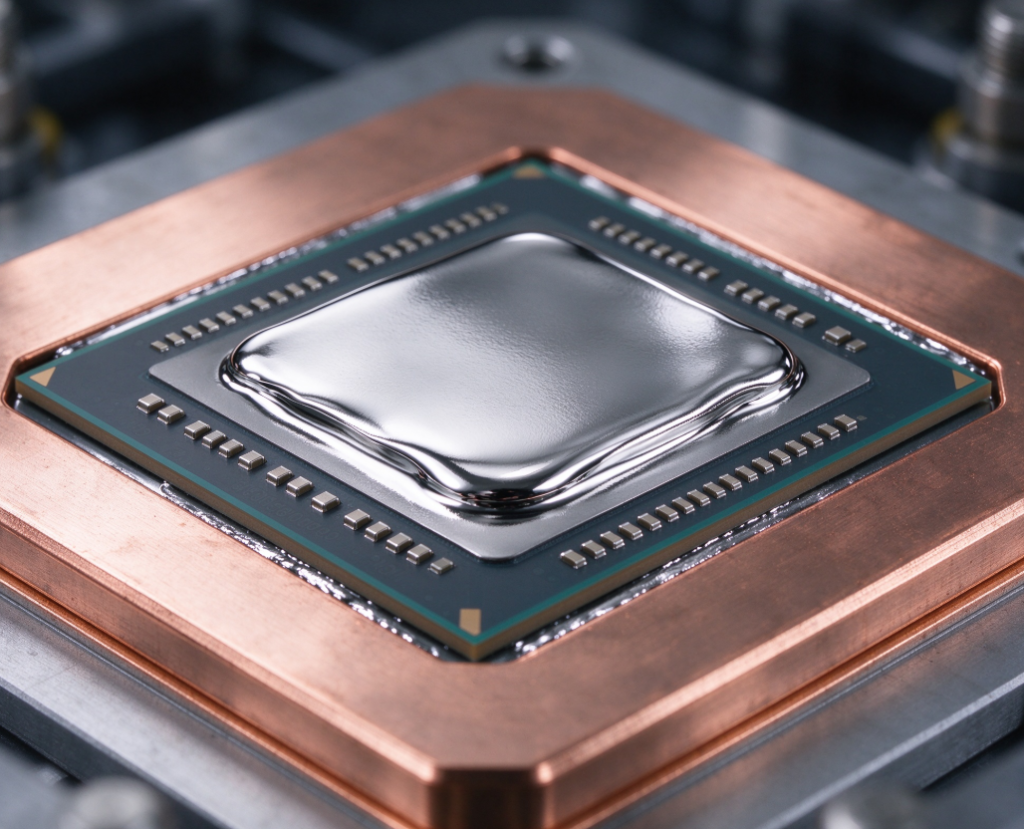
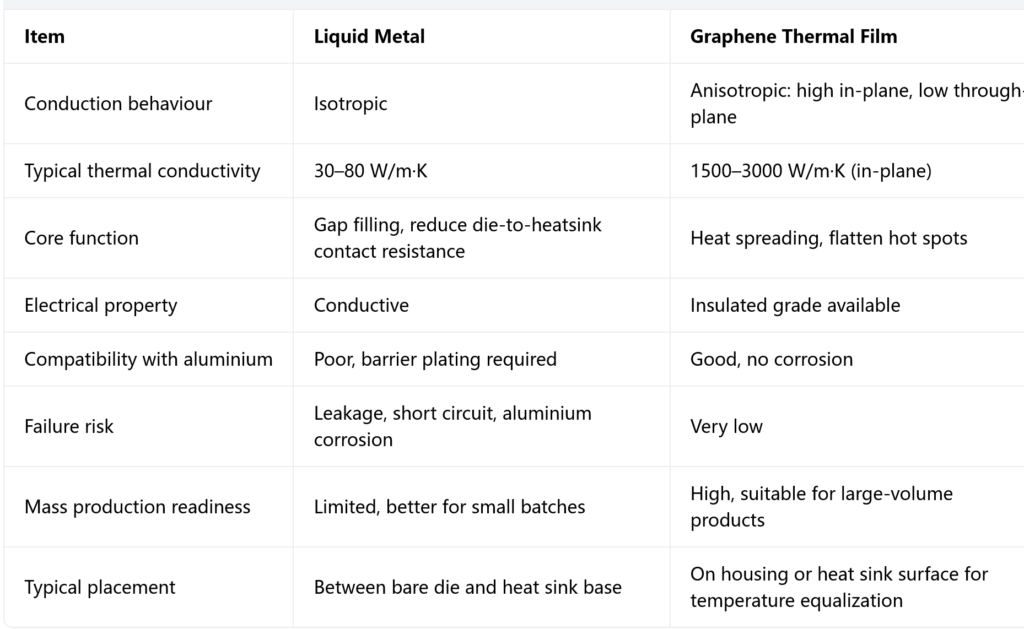
- Liquid metal (gallium alloy): Liquid at room temperature. It is a thermal interface material (TIM) designed to fill contact gaps and cut thermal resistance between die and heat sink. Thermal conductivity: 30~80 W/m·K, isotropic.
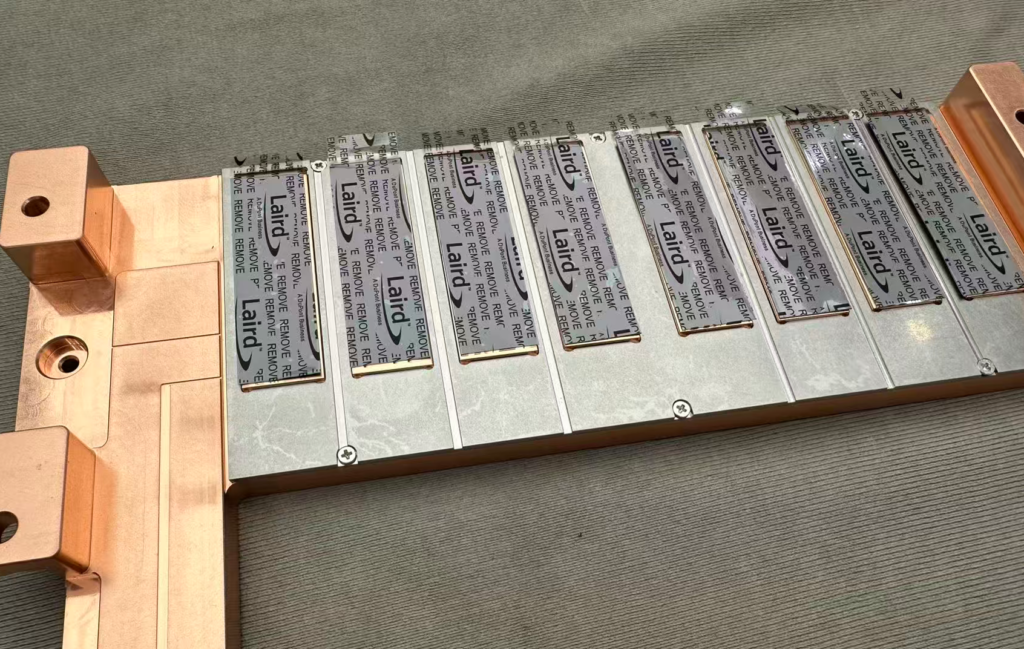
- Graphene thermal film: Solid carbon heat spreader. Heat travels extremely fast along the film plane, with in-plane conductivity from 1500 to 3000 W/m·K. It works poorly through the thickness direction, so it is highly anisotropic.
1. Working Principle
Liquid metal flows and wets metal surfaces. It fills tiny micro-gaps and removes trapped air between two mating parts, delivering very low interfacial resistance. Its job is simple: move heat vertically from the heat source into the heat sink. It stays stable over a wide temperature range and will not dry out like thermal grease.The downsides are obvious. It conducts electricity. Any leak will short out your PCB. Gallium also reacts with bare aluminum. To use it reliably, you need dam structures and proper sealing. Extra process control makes it hard for mass production.
Graphene thermal film spreads heat sideways. It does not fill gaps. Its main job is to take a concentrated hot spot and spread heat across a larger area to even out temperature.
It is a solid sheet. No leakage risk, easy to handle, and insulated grades are available for electronics safety. It works well in high-volume production. However, it cannot fill micro voids between two rigid surfaces, so it cannot replace gap-filling TIMs.
2. Pros, Cons & Engineering Notes
Gallium-based Liquid Metal
✅ Pros
- Ultra-low interfacial resistance, great for heat flux above 120 W/cm²
- Stable across wide temperature range, no dry-out
- Isotropic heat conduction
❌ Cons - Electrically conductive; leakage causes short circuits
- Not compatible with bare aluminum. Nickel or gold plating is required
- Needs dam and sealing design, strict assembly control
- Higher cost, better suited for low-volume custom builds
Graphene Thermal Film
✅ Pros
- Excellent in-plane heat spreading to reduce hot spots
- Solid sheet, no leak risk, easy assembly and rework
- Insulated option available for electrical safety
- Consistent material performance, friendly to mass production
❌ Cons - Strong anisotropy: good sideways, poor vertical heat transfer
- Stiff film, poor conformity on rough surfaces
- Cannot replace gap-filling thermal interface material
3. Suitable Applications
👉 Go with liquid metal:
Ultra-high heat flux bare chips, high-power laser dies, low-volume custom equipment. Contact surfaces are copper or nickel-plated, with space for dam and sealing structure.Not recommended: mass production runs, bare aluminium heat sinks, modules with dense PCB traces.
👉 Go with graphene thermal film:
Hot spot spreading for optical modules, radio units, industrial controls and laser housings. Projects where production yield and safety are top priorities, and aluminium housings or heat sinks are used.
Not recommended: direct gap filling between chip and heat sink when ultra-low interface resistance is required.
👉 Combined solution (widely adopted in premium hardware):
Liquid metal as TIM at the die interface + graphene film for housing heat spreading. This setup achieves both low contact resistance and balanced temperature across the assembly.
4. From the case study of Rubin’s switch from liquid metal to graphene following NVIDIA’s specification change
Cross-verified supply chain news confirms NVIDIA has dropped liquid metal TIM for its Rubin supercomputing GPU, shifting fully to graphite composite TIM paired with MGX cold plate liquid cooling. This million-unit production decision stems from four practical engineering accounts: poor yield, gallium-induced metal corrosion, geopolitical supply risks around gallium, and weak overall TCO advantage. While liquid metal delivers outstanding thermal performance in lab tests, the modest temperature edge it offers cannot offset scrap losses, reliability concerns and extra manufacturing overhead for large-scale data center deployment.
This material pivot also puts vertically aligned graphene TIM into the industry spotlight. Traditional graphite films spread heat well along the plane but perform poorly through thickness. New vertically structured graphene pads build continuous vertical thermal channels, reaching 90–200 W/(m·K) and balancing conductivity, flexibility and long-term stability. A clear three-tier supplier landscape has formed, ranging from volume vendors already serving top AI clients to firms still sampling or developing base graphene powder. Graphene TIMs are expanding from AI GPUs into ASICs, server CPUs, 1.6T optical modules and power semiconductors, though they will not fully replace all existing thermal interface solutions.
Above all, Rubin’s switch signals that AI hardware development is moving beyond chasing extreme lab performance and prioritizing manufacturability, yield and multi-year reliability. The global TIM market keeps growing rapidly, yet the era of blind hype for exotic thermal materials is fading. Only suppliers with verified mass-production capacity and proven field reliability will capture lasting share in this high-growth cooling market, and the commercial rollout of advanced graphene thermal materials is still in its early phase.