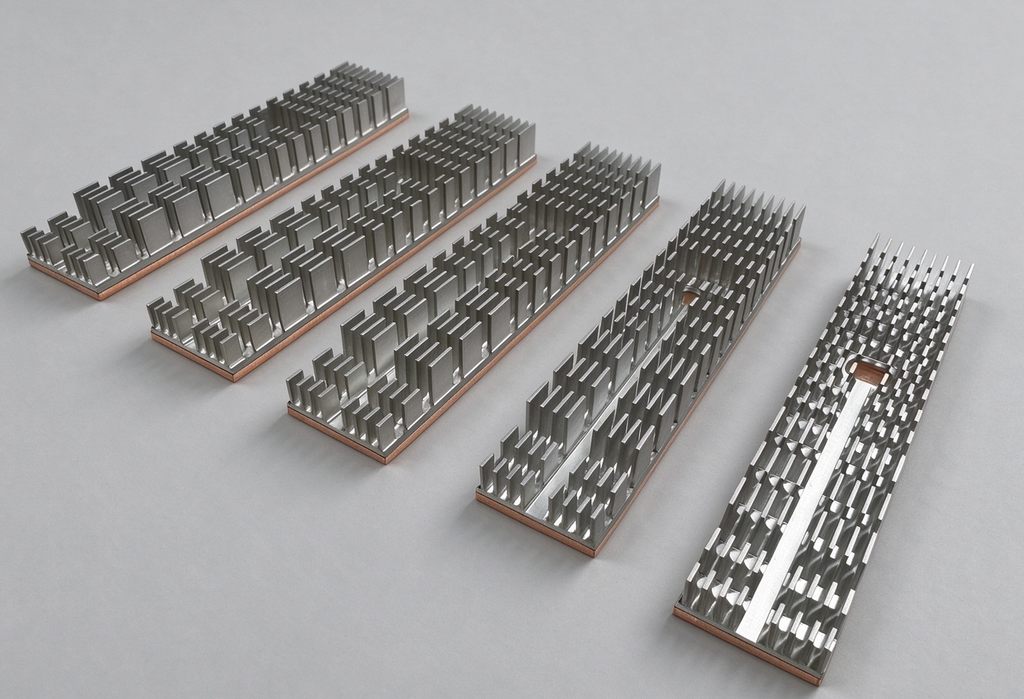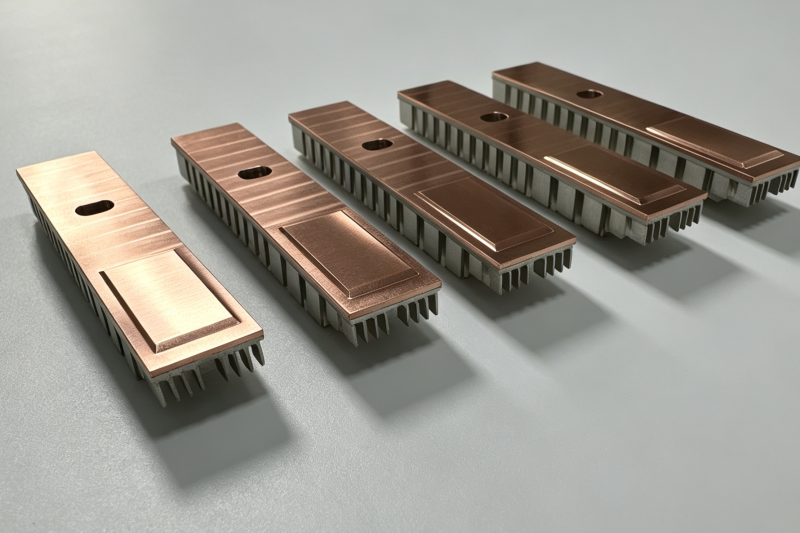
This article is written for thermal design engineers.By reading this article, you will learn about our custom copper-aluminum hybrid heat sinks. The product shown below is our copper-aluminum explosion-welded heat sink, manufactured with skived fin technology and CNC precision machining. This article covers its application solutions for high-speed optical modules, process selection, performance limits, supporting technical details, and also compares the drawbacks of copper-aluminum soldering with solder paste.A Balanced Thermal Solution for 800G / 1.6T High-Speed Optical Modules
1. Definition and basic thermal working principle of copper-aluminum hybrid heat sinks designed for optical modules
Copper-aluminum hybrid heat sinks for optical modules are composite thermal structures built for high-speed optical modules. The heat contact area uses high-thermal-conductivity copper material, while the heat dissipation fins adopt lightweight aluminum material. They are assembled through vacuum brazing, press-fit assembly, explosion welding or solder paste welding, and are specially designed for the thermal interface of pluggable 800G, 1.6T and 3.2T optical modules.
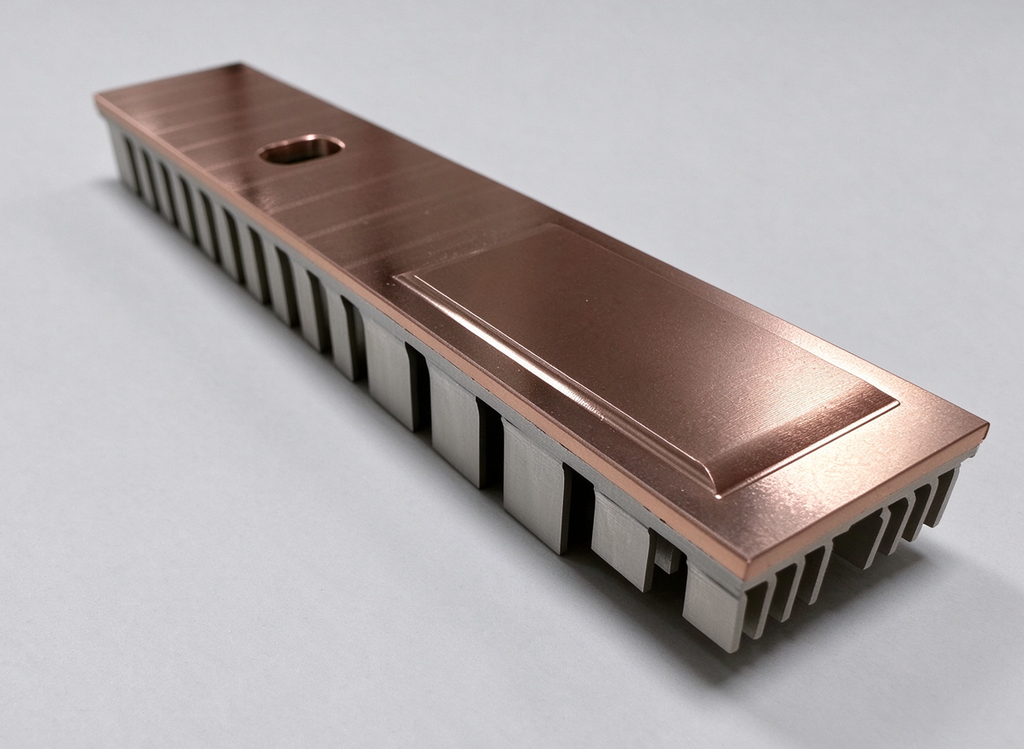
Copper sits close to the heat sources of DSP and laser chips to spread heat rapidly in the horizontal direction. Aluminum fins exchange heat with the airflow inside the chassis to dissipate heat to the ambient environment. It is not a simple stack of two metals, but a thermal structure with divided heat management functions. Our explosion-welded copper-aluminum heat sink can be mass-produced with skived fin and CNC precision machining, which is the sample shown in the pictures above.
2. Thermal challenges of modern high-speed optical modules and why hybrid copper-aluminum design outperforms single‑material options
The core conflict for high-speed optical modules lies in continuously rising power consumption, strictly standardized form factors, and high temperature sensitivity of optical chips. 800G modules run at 15–30W, and 1.6T modules can reach 40–45W, with local heat flux exceeding 100W/cm². Excessive temperature on laser and DSP chips leads to wavelength shift, increased bit error rate, shortened service life, and even forced throttling or disconnection of optical modules.
- All-aluminum heat sinks: Limited thermal conductivity cannot spread hot spots efficiently, resulting in high hotspot temperature, which easily fails for high-power 1.6T applications.
- All-copper heat sinks: Excellent thermal conductivity, yet heavy weight, high raw material cost and complex machining. High port density switches face excessive overall load and higher cost pressure.
- Copper-aluminum hybrid solution: It combines the strengths of both materials. Copper spreads heat quickly, and lightweight aluminum fins support convective cooling. It balances thermal resistance, weight and cost, and has become a mainstream thermal solution for high-speed optical modules in data centers.
3. Introduction of mainstream manufacturing routes, machining control and surface protection specifications for copper‑aluminum heat sinks
Four mainstream copper-aluminum bonding processes are widely used, with different reliability grades and thermal performance:
- Vacuum brazing: Copper base and aluminum fins are machined separately and bonded with brazing filler metal. It delivers low interface thermal resistance, suitable for custom small-to-medium batches and widely adopted for optical module heat sinks. Anti-galvanic corrosion control for copper-aluminum joint is critical. Surtec‑650 passivation is applied after welding.
- Press-fit copper insert: Slots are machined on an aluminum base, and copper inserts are pressed into the slots to align with hot spots. It costs less and suits mass production, with slightly higher thermal resistance than brazed versions. It fits 800G and lower-power optical modules.
- Explosion-welded copper-aluminum substrate: Atomic-level metallurgical bonding, the highest interface strength, lowest thermal resistance and excellent stability under thermal cycling. The custom sample shown above uses explosion-welded substrate combined with skived fins and CNC precision machining, mainly used for high-reliability 1.6T / 3.2T projects.
- Solder paste bonding for copper and aluminum: Copper base plate paired with nickel-plated aluminum fins connected by solder paste. This process has obvious weaknesses. The solder paste layer introduces extra interface thermal resistance and reduces heat transfer efficiency. Under repeated high-low temperature cycles, mismatched thermal expansion coefficients of copper, aluminum and nickel plating trigger microcracks and voids in solder joints, and thermal resistance rises gradually. It is not suitable for high-power high-reliability high-speed optical modules.
Key machining requirements:
- Flatness and roughness of contact surfaces are tightly controlled to guarantee good contact with optical module housings.
- Skived ultra-thin dense fins are optional to enlarge heat exchange area.
- Passivation or conductive anodization is applied to meet RoHS requirements and anti-corrosion standards for data center environments.
- Thermal cycling test from -40℃ to 125℃ verifies no delamination or cracking at the bonding interface.
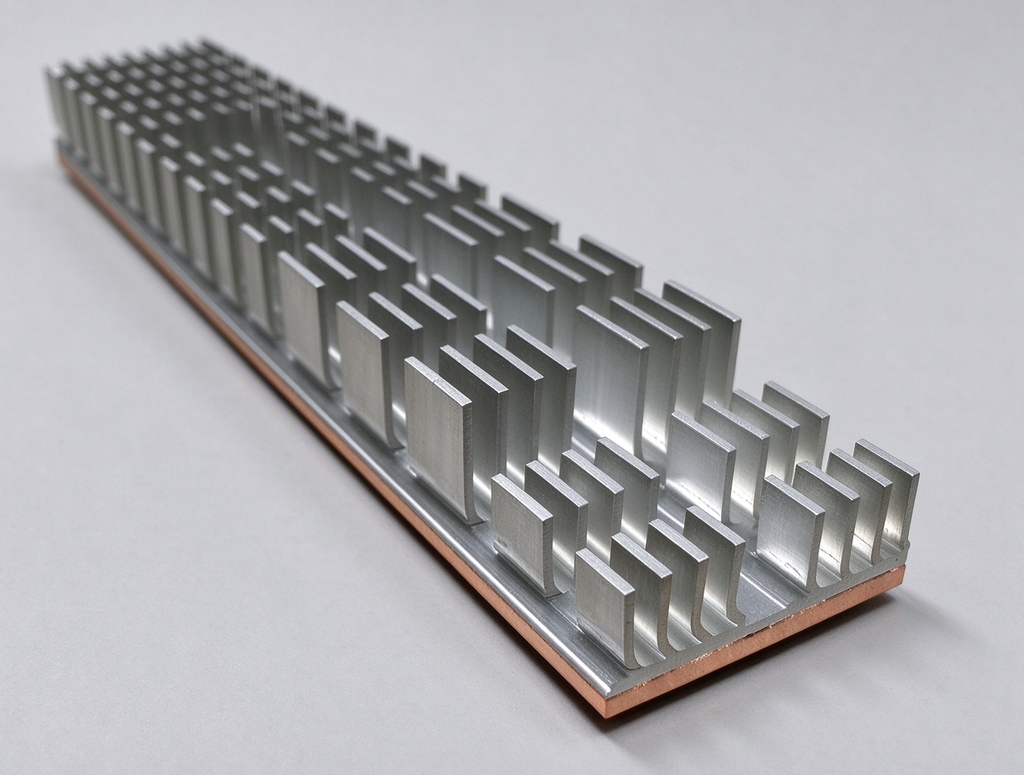
4. Side-by-side comparison of all-aluminum, solder-paste bonded copper-aluminum, brazed/press-fit copper-aluminum and explosion-welded copper-aluminum heat sinks on thermal performance, weight, cost and cycling reliability
| Solution | Hot spot spreading | Weight | Cost | Interface reliability | Interface thermal resistance | Application scenarios |
|---|---|---|---|---|---|---|
| All-aluminum heat sink | Fair | Light | Low | Good | Low | 400G and lower-power optical modules |
| Solder-paste bonded Cu-Al (Cu base + Ni-plated Al fins) | Good | Medium | Low | Poor | High | Low-power applications with loose thermal resistance requirements |
| Brazed / press-fit Cu-Al heat sink | Good | Medium | Medium | Good | Medium | Mainstream 800G and regular 1.6T optical modules |
| Explosion-welded Cu-Al heat sink with skived fin | Excellent | Medium | Medium-high | Excellent | Lowest | High-reliability 1.6T / 3.2T optical modules |
| All-copper heat sink | Outstanding | Heavy | High | Excellent | Low | Ultra-high heat flux, prototype and small-batch projects |
Important note: Copper and aluminum are dissimilar metals with galvanic corrosion risks. Interface sealing and surface passivation are critical for humid data center environments. Solder paste bonding carries additional risks of solder voids and drifting thermal resistance, so we do not recommend it for high-power optical modules.
5. Application range and usage limits of copper-aluminum hybrid heat sinks for different optical modules and deployment environments
✅ Suitable: 800G, 1.6T DR8 / FR8 pluggable optical modules, optical ports for AI data center switches, LPO linear drive optical modules, high-speed coherent optical modules. Our explosion-welded skived fin version is prioritized for 1.6T / 3.2T projects requiring long-term thermal cycling and high stability.
✅ Deployment environments: Air-cooled chassis, front-to-back airflow switches, high-density server optical interconnection.
❌ Not recommended: Immersion liquid-cooled optical modules (all-copper or diamond heat sinks are preferred), outdoor base stations with heavy salt spray without protection. Solder paste bonded copper-aluminum structures are not recommended for high-power optical modules.
6. FAQ about thermal resistance, interface delamination and compatibility with standard optical module footprints
Q1: What thermal resistance can copper-aluminum heat sinks achieve?
A: Standard 800G brazed copper-aluminum heat sinks reach 0.3–0.6℃/W under specified airflow, 20%–35% lower than equivalent all-aluminum designs. The explosion-welded skived fin version achieves even lower thermal resistance for higher heat flux. Solder paste bonded Cu-Al designs show significantly higher thermal resistance under identical geometry due to the solder paste layer.
Q2: Will the copper-aluminum interface separate after operation?
A: It depends on the bonding process. Vacuum brazing and explosion welding form metallurgical bonding and remain stable after thousands of thermal cycles. Our explosion-welded substrate features atomic bonding and much better anti-delamination performance than epoxy bonding and solder paste bonding. For solder paste bonded structures, thermal expansion mismatch between copper and aluminum creates micro gaps after repeated temperature swings, and thermal resistance keeps worsening. We do not recommend solder paste bonding for primary heat dissipation of optical modules.
Q3: Can they match standard form factors such as OSFP and QSFP‑DD?
A: Yes. We follow standard industry outlines and support custom fin height, fin density and mounting bosses. The explosion-welded skived fin solution supports custom geometry as well. The second photo shows multiple samples in different custom sizes.
What can we help you from Kenfa Tech?
KENFA TECH supplies custom copper-aluminum hybrid heat sinks for optical modules, including explosion-welded copper-aluminum substrates with skived fin and CNC precision machining. Vacuum brazing and press-fit options are also available. We help customers avoid risky solutions such as solder paste bonding according to power, thermal resistance and reliability targets. We provide thermal simulation, prototype testing and full FQC inspection. If you are developing thermal solutions for 800G / 1.6T / 3.2T high-speed optical modules, send your drawings, power consumption and airflow specifications, and we will deliver thermal simulation reports and quotations.So you can email to us king@kenfatech.com