
Abstract:
Outdoor high-power inverters, LED stage lights, and energy storage IGBT devices consistently operate under harsh working conditions including high thermal load, outdoor humid and salt spray environments, and dust weathering. Conventional thin-walled heat pipe radiators commonly suffer from insufficient structural strength, easy deformation, corrosion, and rapid heat dissipation attenuation. Based on practical engineering experience, this paper analyzes the actual operating pain points of field equipment, demonstrates the design necessity of heat pipes with a wall thickness of no less than 1.0 mm, and systematically elaborates the application value of dual anti-corrosion processes (powder coating and baking finish) in outdoor high-power heat dissipation equipment. It provides a reliable structural and process solution for the long-term and stable heat dissipation of outdoor high-power equipment.
1. Industry Status and Engineering Pain Points
With years of field experience in outdoor thermal matching projects, failure statistics of high-power optoelectronic, energy storage, and power inverter equipment indicate that over 35% of outdoor equipment failures are indirectly caused by radiator heat dissipation failure, shell corrosion, and heat pipe structural damage. Unlike indoor constant-temperature, dust-free, and corrosion-free environments, outdoor scenarios involve multiple adverse factors such as excessive heat, high humidity, intense ultraviolet radiation, acid-base dust, and mechanical vibration. Standard ordinary radiators cannot meet the requirements of long-term all-weather operation.
1.1 Operating Pain Points of Outdoor High-Power Inverters
High-power inverters operate continuously at full load with highly concentrated heat density on power modules, requiring extremely high heat dissipation speed and uniformity. Traditional thin-walled heat pipe heat sinks generally have a wall thickness of only 0.6–0.8 mm. Long-term cyclic thermal expansion and contraction easily cause micro-deformation of pipe walls and attenuation of heat pipe vacuum, resulting in a significant drop in thermal conductivity. Meanwhile, rain erosion and oxidation rust in outdoor cabinet and field power station environments lead to fin scaling and air duct blockage, ultimately triggering overheating alarms, power derating, and even shutdown damage of inverters.Under thermal shock conditions, heat pipes are prone to freezing of the internal working fluid at extremely low temperatures of −10 to −25 °C, which can cause the heat pipe to bulge. Therefore, a wall thickness of 1.0 mm is critical. At the same time, the working fluid charge volume must be strictly controlled, and reliability tests should be repeated.
1.2 Operating Pain Points of Outdoor LED Stage Lights
LED stage lights are mobile outdoor high-power equipment that frequently undergoes handling, vibration, sun exposure, and rain erosion. Thin-walled radiators feature poor mechanical impact resistance. Long-term vibration increases the fitting gap between heat pipes and heat dissipation bases, raising thermal resistance. In addition, ordinary surface treatment processes have poor weather resistance and are prone to peeling, rusting, and whitening aging. These defects not only damage the equipment appearance but also continuously reduce heat dissipation stability, shorten lamp service life, and increase operation and replacement costs.
1.3 Operating Pain Points of IGBT Modules in Energy Storage Equipment
IGBT modules are core precision power conversion components of energy storage systems and are extremely sensitive to operating temperature fluctuations. Excessive temperature variation directly causes power attenuation, increased switching loss, and accelerated device aging. Outdoor energy storage stations feature high humidity and numerous corrosive media. Conventional radiators without enhanced anti-corrosion protection are susceptible to metal oxidation and corrosion, resulting in degraded heat dissipation contact and continuous attenuation of thermal efficiency. In severe cases, it leads to unstable grid connection of energy storage systems and equipment tripping risks.
| Outer Diameter (mm) | Length (mm) | Heat Dissipation (W) | Burst Pressure t=0.5mm (MPa) | Burst Pressure t=1.0mm (MPa) | Liquid Mass in Wick (g) |
|---|---|---|---|---|---|
| 6.35 | 100 | 70 | 11.02 | 22.05 | 0.047 |
| 8 | 100 | 100 | 8.75 | 17.5 | 0.078 |
| 9.52 | 100 | 140 | 7.35 | 14.71 | 0.111 |
| 10 | 100 | 160 | 7 | 14 | 0.123 |
| 12 | 100 | 220 | 5.83 | 11.67 | 0.174 |
| 16 | 100 | 300 | 4.38 | 8.75 | 0.29 |
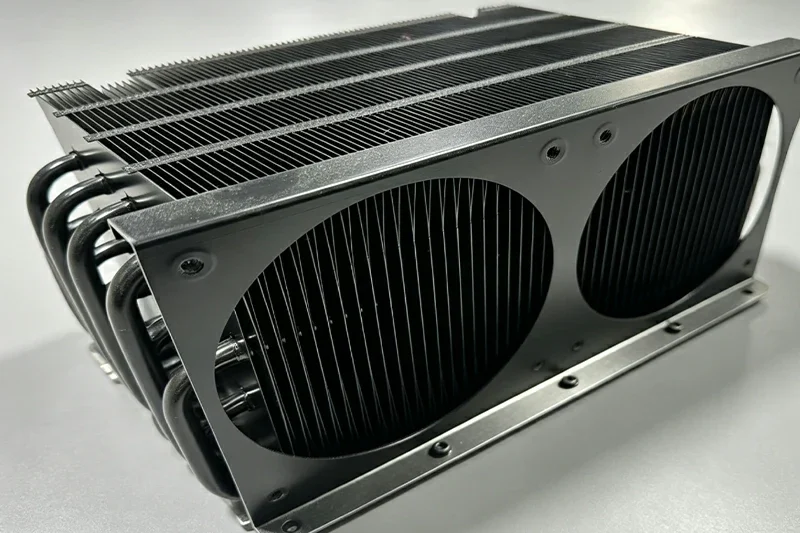
To meet the high-strength, high-load, and high-durability operation requirements of outdoor high-power equipment, this radiator adopts a customized high-efficiency heat dissipation structure equipped with 20 heat pipes with a diameter of 9.52 mm and strictly implemented heat pipe wall thickness greater than 1.0 mm. Each single heat pipe is designed with a maximum heat dissipation power of 100 W. Considering the gravity direction influence on actual heat transfer efficiency in outdoor installation scenarios, a conservative efficiency coefficient of 0.85 is adopted for performance calibration, enabling each heat pipe to stably dissipate 85 W of heat under actual working conditions. In terms of assembly technology, the heat pipes and nickel-plated aluminum base plate are connected through high-precision solder paste welding to minimize interface thermal resistance and ensure tight and stable thermal contact. Different from thin-walled radiators for civil and indoor light-duty applications, this structural and technological optimization fundamentally solves the problems of deformation, heat transfer failure, and short service life in harsh outdoor working conditions.
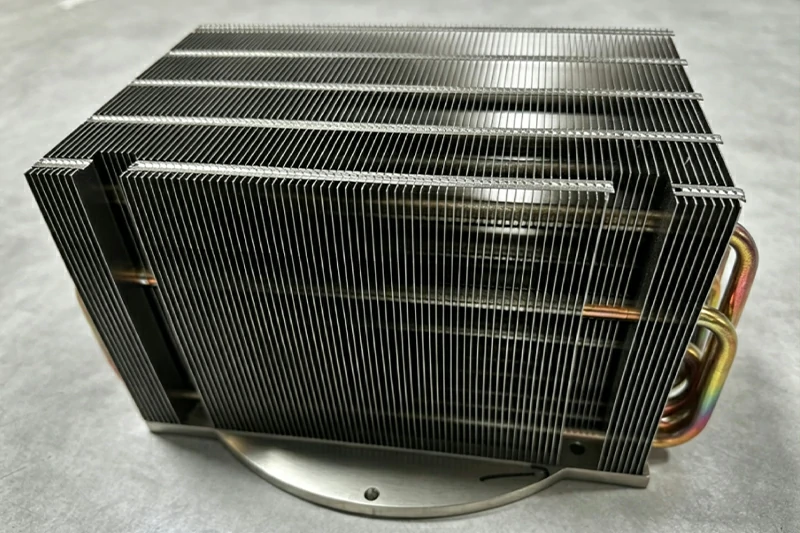
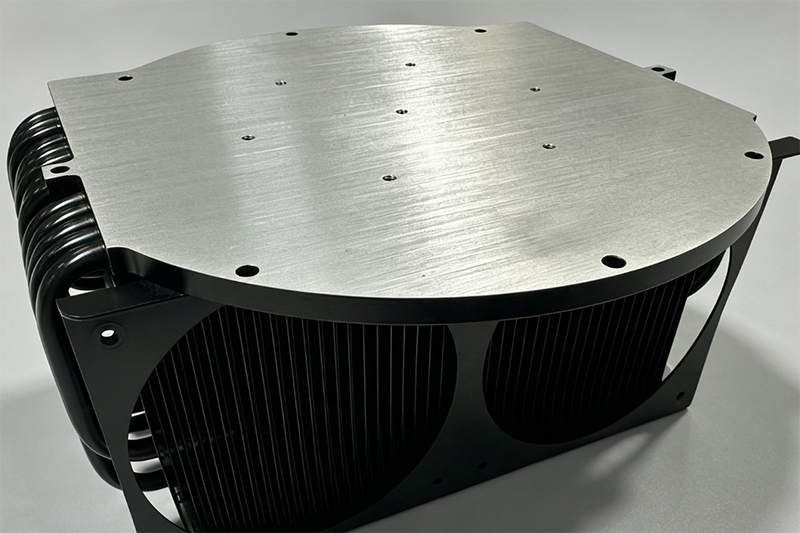
The two heat sinks in the images show the results after solder paste welding and surface treatment. The first one uses solder paste welding at 160℃, and oxidation occurs on the heat pipe surface after welding. Processes for the second include degreasing, alkaline cleaning, passivation and powder coating to remove oxide layers, improve corrosion resistance and visual appearance. The powder coating thickness is around 100μm, which can pass the cross-cut test and withstand 120 hours of salt spray test without oxidation.
2.1 Improved Structural Fatigue and Deformation Resistance
Heat pipe wall thickness determines the structural stability of the heat dissipation core. Thickened walls of 1.0 mm and above deliver superior mechanical strength, effectively resisting continuous equipment vibration, high-temperature thermal stress, and alternating cold and hot impact. They avoid common defects of thin-walled pipes such as wall depression, micro-cracks, and pipe deformation. The stable pipe structure maintains long-term internal vacuum and working medium status of heat pipes, eliminating thermal conduction failure and ensuring continuous and stable operation of the heat dissipation system under high-power conditions.
2.2 Sustained Heat Conduction Efficiency for High-Power Operation
High-power equipment features instantaneous high heat generation and high heat flux density, requiring strict stability of heat pipe thermal conduction. Thickened heat pipes possess enhanced structural rigidity with no thermal deformation and stable heat conduction channels. They rapidly and evenly remove concentrated heat from IGBT modules, inverter power boards, and LED light source modules, avoiding local heat accumulation and heat dissipation lag. This effectively controls the temperature rise of core components and ensures full-power non-stop operation without power derating.
2.3 Extended Overall Service Life of Heat sinks
Outdoor equipment operates uninterruptedly all year round, demanding excellent aging and fatigue resistance for radiators. Thickened walls deliver improved high-temperature aging resistance and medium corrosion resistance with negligible performance attenuation under long-term alternating cold and hot cycles. Compared with traditional thin-walled heat pipe radiators, the overall service life is significantly extended, effectively reducing subsequent equipment maintenance, replacement, and shutdown loss costs.
3. Anti-Corrosion Process Upgrade: Dual Outdoor Protection of Powder Coating and Baking Finish
Apart from structural defects, corrosion and aging are the primary causes of radiator failure. Bare metal and simply sprayed radiators cannot resist outdoor ultraviolet radiation, rain, moisture, and acid-base dust erosion. Therefore, this high-power heat pipe radiator adopts enhanced anti-corrosion treatment adopts high-quality baking finish technology as the core protective process, complying with industrial-grade outdoor equipment protection standards.3.1 Electrostatic Powder Coating: Wear-Resistant, Anti-Corrosion and Full-Coverage ProtectionAdopting industrial electrostatic powder coating technology, the coating features strong adhesion and dense and uniform texture.
It fully covers heat pipe walls, heat dissipation fins, splicing gaps, and edge dead corners to form a complete insulating and anti-corrosion protective layer. The high-hardness coating resists friction and collision, withstands outdoor dust scouring and handling vibration wear, and isolates the metal matrix from air, moisture, and corrosive media to prevent oxidation rust and pitting damage.3.2 High-Temperature Baking Finish: UV-Resistant and Long-Term Stable Weather ResistanceThe matched high-temperature baking finish boasts excellent airtightness, flatness, and UV resistance. It stably withstands long-term outdoor strong sunlight exposure, sharp temperature changes, and humid and rainy environments without peeling, cracking, fading, or falling off. The superposition of dual processes endows the radiator with industrial-grade performance including wear resistance, corrosion resistance, weather resistance, and aging resistance, adapting to various harsh outdoor operating scenarios.
4.Application Value and Practical Advantages
Verified by multiple field application cases of outdoor high-power equipment, radiators with ≥1.0mm thickened heat pipes and dual anti-corrosion processes exhibit outstanding practicality and stability in inverters, outdoor LED stage lights, and energy storage IGBT equipment. The core practical advantages are summarized as follows:
*Higher Structural Reliability: Thickened heat pipes resist vibration and thermal expansion & contraction impact, eliminating heat pipe deformation, failure and liquid leakage, and adapting to long-term full-load continuous operation of high-power equipment;
*More Stable Heat Dissipation Performance: Constant heat conduction channels and stable thermal resistance accurately control the temperature rise of power components, avoiding high-temperature power derating and equipment shutdown failure;
*Stronger Outdoor Weather Resistance: Professional baking finish anti-corrosion treatment thoroughly solves outdoor corrosion, aging and peeling problems, greatly extending the service life of equipment and radiators;
*Lower Comprehensive Operation and Maintenance Costs: High durability and low failure rate reduce equipment inspection, replacement and shutdown losses, perfectly meeting the long-term operation and maintenance needs of industrial and commercial outdoor equipment.
5. Conclusion
The heat dissipation difficulties of outdoor high-power inverters, LED stage lights and energy storage IGBT equipment lie not merely in insufficient heat dissipation area, but in structural strength failing to adapt to high-power working conditions and protective processes failing to adapt to outdoor environments. The adoption of heat pipes with a wall thickness of more than 1.0 mm fundamentally improves the structural strength and thermal conduction stability of heat dissipation cores. The matched industrial-grade professional baking finish anti-corrosion process comprehensively enhances outdoor weather and corrosion resistance. This solution effectively solves the industry pain points of high-temperature failure, corrosion aging and short service life of outdoor high-power equipment, serving as a highly reliable heat dissipation scheme for outdoor high-power optoelectronic, energy storage and power equipment.
This document on surface treatment methods for heat pipe heat sinks is intended to be helpful for your project. In our subsequent discussions, we will continue to cover anti-corrosion processes for outdoor heat sinks, including liquid cold plates, such as spray painting and trivalent chromium chromate conversion treatment. If you have any additional requirements or questions, please feel free to email us — our engineers will be glad to provide you with detailed explanations. We are not only a thermal management manufacturer of heat sinks and liquid cold plates, but also a provider of full-stack thermal management system services to our customers.you can email to us:
king@kenfatech.com
Whatsapp/Tel:+86 13922909212